
Hands-On Experience Building at the TTC: TTC Operated by ENSCO
Written by Robby White


PUEBLO, Colo. - ENSCO, Inc.'s Matthew Dick and Gregory Holtman demonstrate the importance of hands-on experience through the first TTC Derailment Investigation and Prevention Workshop.
Return on Investment (ROI) is a critical metric for any organization considering improvements. In the case of training, one element of ROI is information retention: how well a student retains knowledge to be more effective in their job duties. This raises the question: what makes training impactful?
A 2025 study from the National Center for Construction Education and Research concluded that On-the-Job Training (OJT) in real-world situations under expert mentorship is the most impactful method of training.[1] The study also found that OJT is further enhanced when paired with logical classroom instruction. We all know OJT is an extremely valuable and effective method of training. But why is that the case? Certainly, its strength lies in hands-on experiences in real-world conditions. However, a deeper look reveals more to it. A paper in the Journal of Technology Education found that hands-on training, engaging tactile and motor functions, triggers more brain activity compared to classroom training, which relies solely on visual and auditory experiences.[2] This broader brain stimulation helps set deeper, longer-lasting memories. The next question is how to obtain these invaluable hands-on experiences with an expert mentor when that resource does not already exist within your railway organization. The TTC has addressed this challenge and recently completed its first initiative built around these principles.
Derailment Workshop
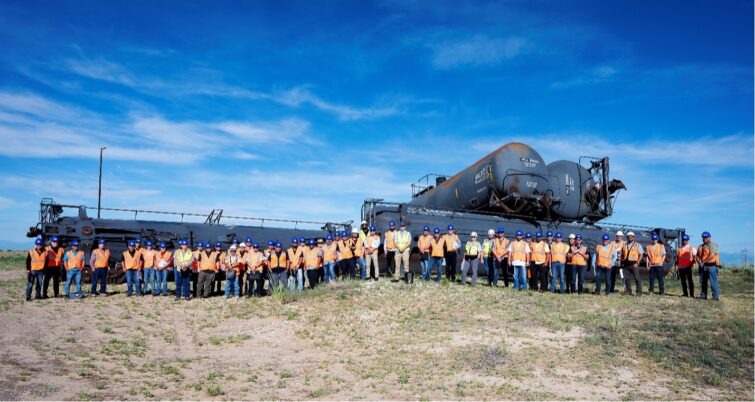
On July 22-24, the TTC hosted the first Derailment Investigation and Prevention Workshop. The attendees were 51 students including representation from 18 different railways, as shown in Figure 1. The workshop leveraged the mantra “Tell me and I will forget, show me and I may remember, involve me and I will understand.” This was done with active round table discussions among the attendees discussing their own derailment experiences and challenges interwoven between the hands-on and classroom sessions.
Expert mentorship was provided by the workshop leaders, Matthew Dick and Greg Holtman. Matthew has over 25 years of experience investigating and preventing derailments, beginning with his time at the Union Pacific R&D Lab operated by Rail Sciences, Inc. During his tenure there, he leveraged his background in metallurgy and computer simulation to investigate approximately 250 derailments across all Class 1 railroads and many short line and passenger transits, including serving as an onsite subject matter expert during the 2008 Chatsworth Collision NTSB investigation. In addition, Matthew has applied his derailment prevention expertise throughout his career, including the use of innovative technologies.
Greg has more than 15 years of experience in railway operations and training, starting with his work as a Conductor and Switchman for Union Pacific. He later served at RTD-Denver as a Transportation Rules Trainer and Manager, where he revised critical operating rulebooks and oversaw control center operations, followed by leading all transportation training and certification programs. In his current role at the TTC, operated by ENSCO, he develops and delivers both field and classroom training, drawing on his extensive operational expertise.
The workshop’s success was also made possible through the invaluable support of numerous technical professionals at the TTC.
Hands-On Sessions
Attendees experienced multiple hands-on sessions throughout the event. This included conducting a site inspection of the mock derailment shown in Figure 1. Attendees utilized best practices to record car positions, orientations, and identifying information, along with the discussed methodology of how to identify the Point-of-Derailment (POD) and the first derailed car. Collecting this information is important to understand how the cars are situated in the pile up because that can provide insights into the investigation.
Another hands-on session was conducting real-world inspections of thirty-two different component failures that can lead to derailments, depicted in Figure 2. An important aspect of this activity was accurately identifying defective conditions that are the cause of a derailment, rather broken components that were caused the derailment event. This is key to ensure accurate derailment cause finding. It’s common that at a derailment site there are lots of broken components such as broken rail and wheels. But were any of them the cause of the derailment? There are specific characteristics on a broken rail or broken wheel that caused the derailment vs. being caused by the derailment. This includes rail end batter and batter on a broken wheel. Additionally broken wheels have additional damage on their tread from continuing to roll on the track prior to the derailment.
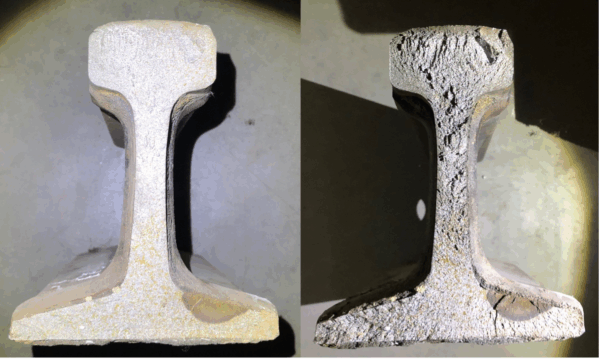
Attendees also had the opportunity to have hands-on experience with failed component photography best practices. Many times, the field personnel are the only ones that can get critical photographs needed for the investigation. Capturing quality photographs, particularly at nighttime, can be a challenge as shown in Figure 3. Using photography best practices can make sure that important features of the fracture surface are captured so that an accurate investigation can be made. In the case of Figure 3, it is a broken weld caused by a fatigue crack initiated at the base. Often at a derailment, the broken rail is heavily damaged. But by using the method shown on the right side of Figure 3 where a flashlight was shining from the side, the features of the fracture surface stand out well, allowing a metallurgist investigator clearly to identify where the fracture surface initiated from, even if the broken rail is damaged.
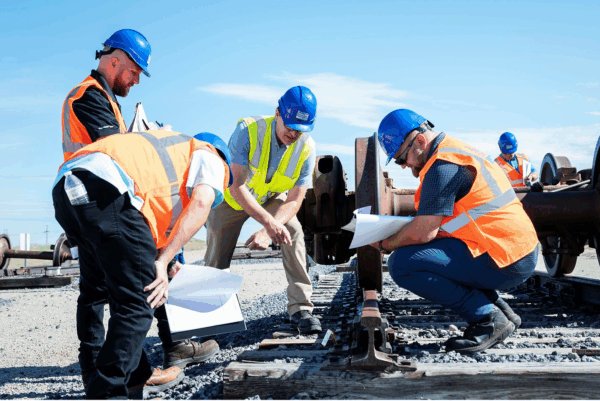
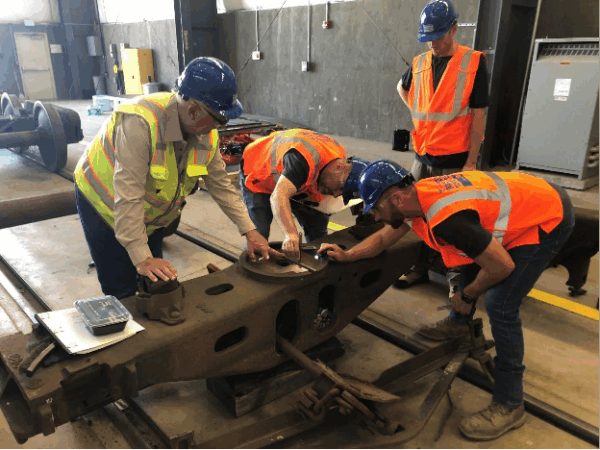
A unique aspect of the workshop was that it had both track and rolling stock (mechanical) attendees and both got the opportunity to experience hands-on activities that they wouldn’t normally have in their typical job duties. Figure 4 is one of these hands-on sessions which was conducting a first derailed car inspection. Attendees performed inspections on both freight and passenger railcars using all the necessary gauges and measurements to fill out an inspection form. This included using finger gauges that are needed for assessing wheel wear such as a thin flange which can play a role in a switch point derailment. This unique session allowed non-rolling stock staff to have memorable experiences to enable them to be better informed when conducting a derailment investigation. Depicted in Figure 4 are attendees performing a center bowl measurement. Issues with a center bowl are one of multiple railcar factors that can play a role in increasing lateral wheel force, which can be a contributor to wheel climb, rail rollover, and gauge widening derailments.
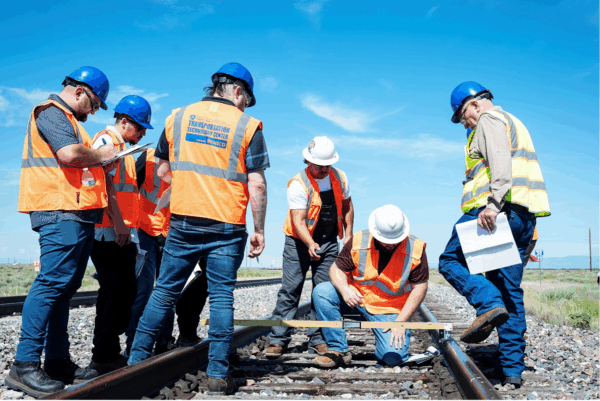
Similarly, attendees had the opportunity to identify a POD and take track geometry measurements at 15.5-foot stations both leading up to and following the POD. Figure 5 shows attendees making these station measurements themselves. Each participant measured gauge, crosslevel, profile, and alignment using a level board and stringline. Additionally, they applied best practices to adjust the unloaded track geometry measurements so they would be representative of loaded conditions. This was an excellent opportunity for new railway professionals to gain hands-on experience in inspecting and measuring track.
Conclusion
The TTC recently completed its first Derailment Investigation and Prevention Workshop, which featured impactful hands-on experiences in a real-world environment with expert mentors. Below are examples of feedback from attendees:
“ It was an honor to attend the workshop. I have attended over 11 classes in my career with BNSF, UPRR, Metrolink, Arema, and other contracted contractors. ENSCO was the most informative with understanding how all departments look at derailments from each angle, key notes and measuring tools that everyone uses. The big difference is in the field with is the most valuable information. In every other workshop that I have attended, there was not field exercise with any of the station that ENSCO had. Which was easier to explain to my co-workers how this all ties together.” – Rafael Gutierrez Jr., MOW Senior Instructor/Supervisor, RTD-Denver
“It is obvious to me that tremendous preparation, coordination, and organization went into the event. Over the years, I have attended numerous courses and instructional events in my railroad career. I can say unequivocally that Matthew Dick was top notch. A truly outstanding instructor! I feel extremely fortunate to have been a participant in this comprehensive workshop.” – Ernest Montgomery, State Investigator, New Mexico DOT
The next TTC Derailment Investigation and Prevention Workshop is scheduled for March 24–26, 2026. It is open to all organizations and is expected to sell out early again. More information can be found at ttc-ensco.com/derailment-workshop.
References:
- https://www.nccer.org/media/2025/06/NCCER-ROI-From-Training-to-Performance-Report_2025.pdf
- https://jte-journal.org/articles/10.21061/jte.v1i2.a.3


Leave a Reply