Rail Neutral Temperature: Moving from Research to Reality
Written by Acacia Reber & Radim Bruzek ENSCO


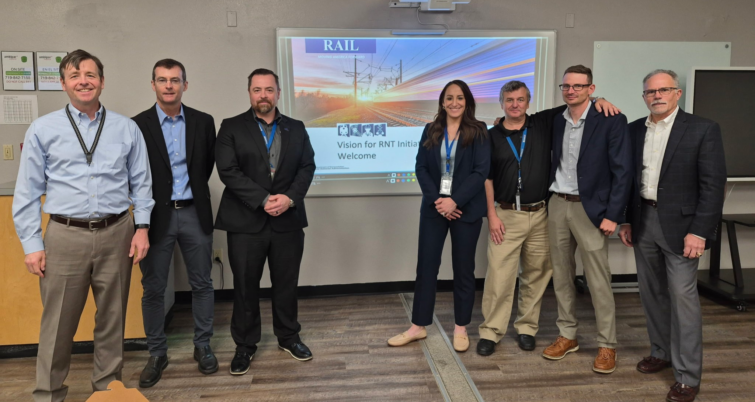
Left to right: Robert Wilson (FRA), Scott Cummings (MxV Rail), Alex Seredich (ENSCO), Acacia Reber (ENSCO), Radim Bruzek (ENSCO), Stephen Wilk (MxV Rail), and Mark Patterson (FRA)
PUEBLO, Colo. –– FRA-led collaborative initiatitive meeting on rail neutral temperature. Railway Track and Structures, "TTC Operated by ENSCO," July 2026.
Continuous welded rail (CWR) has become the foundation of modern railroad infrastructure across the United States, enabling higher train speeds, greater axle loads, reduced maintenance costs, and improved ride quality compared with traditional jointed rail. CWR reduces impact loading, minimizes component wear, and improves overall track reliability and operational efficiency. These advantages, however, come with a critical engineering challenge: the management of longitudinal forces within the rail. Temperature changes induce significant tensile or compressive forces as the rail attempts to contract in cold conditions or expand during elevated temperatures. These forces can lead to failures such as pull aparts for cold temperatures or track buckles in hot temperatures.
Effective CWR management depends primarily on the interaction of three key factors: rail neutral temperature (RNT), track lateral strength, and actual rail temperature. RNT represents the temperature at which the rail is free of longitudinal stress. While many additional factors influence CWR management, these three parameters are the most critical, with RNT being particularly important because it fundamentally determines the magnitude and state of thermal stresses acting within the rail.
While a variety of techniques have been developed over time to monitor or estimate rail neutral temperature, the technologies remain intrusive, labor-intensive, or dependent on known reference. Conventional approaches rely on strain gages and thermocouples attached to the rail and require rail cutting to establish reference stress. Other techniques, such as the VERSE method, require partial rail unfastening to directly measure the rail’s response. While these methods can provide useful results, they typically require track access, traffic interruption, specialized installation, or physical disturbance of the track structure. As a result, the railroad industry has long pursued what is often considered the “holy grail” of CWR management: a reference-free, nonintrusive, and ideally non-contact method for measuring RNT under revenue-service conditions. Despite decades of research, a practical and universally accepted solution remains elusive. This challenge is the focus of a recent Federal Railroad Administration (FRA)-led collaborative initiative with the industry. Its inaugural meeting, organized by FRA, ENSCO, and MxV Rail, was held on April 28, 2026, at the Transportation Technology Center (TTC) in Pueblo, Colorado.
The meeting brought together representatives from railroads, government, suppliers, research organizations, and universities to discuss the current state of RNT measurement technologies and identify pathways to mature the technologies and enable practical deployment within two years.
The objective was not simply to review research already underway, but to align the industry and researchers around realistic requirements and technologies that could move from concept to implementation.
“The goal is not just advancing research for the sake of research,” said Robert Wilson, Acting Chief of the FRA’s Track Research Division. “The focus is on identifying approaches that railroads can realistically deploy, maintain, and use in everyday operations.”
Why RNT Measurement Remains Challenging
Reference-free measurement of rail neutral temperature is fundamentally challenging because RNT is not a directly observable physical quantity but rather an inferred stress-free state that exists only under specific thermal and mechanical conditions. In practice, rail stress is influenced not only by temperature but also by complex interactions among rail restraint, ballast resistance, fastener behavior, residual manufacturing stresses, maintenance activities, and other factors, making it extremely difficult to isolate thermally induced longitudinal stress from other mechanical influences. Furthermore, the sensing technologies investigated to date generally rely on secondary phenomena, such as strain response, vibration characteristics, wave propagation, modal dynamics or piezospectroscopy, which are themselves highly sensitive to environmental conditions, rail support variability, and material inconsistencies. Equally important, railroads require solutions that can be seamlessly integrated into existing maintenance and operating practices without disrupting revenue service. This practical consideration recurred throughout discussions at the TTC meeting. Participants noted that technical merit alone is not sufficient for industry adoption if a measurement system requires extended track occupancy, restrictive environmental conditions, specialized personnel, or complex calibration procedures that are difficult to implement and sustain across large rail networks. Participants also noted that any solutions capable of detecting indicators of track buckling risk, such as locations with significantly decreased RNT, while monitoring substantially larger portions of the rail network, may offer significant safety benefits and help reduce track-buckling-related derailments, even without directly measuring RNT.
A Shift Toward Practical Deployment
The April meeting represented a broader shift in how the FRA and industry approach RNT measurement development efforts. Historically, research into RNT measurement technologies has involved numerous independent studies exploring different physical principles and sensing approaches. While many of those efforts advanced technical understanding, none have yet translated into commercially viable tools.
During the recent FRA-led meeting, FRA leadership emphasized the need to move beyond isolated research efforts and establish a coordinated path toward commercialization, with a goal of identifying and validating promising technologies within the next two years. Discussions highlighted the continuing importance of RNT as a key component of (CWR) management, while also acknowledging that RNT alone does not determine track stability. Railroad participants stressed the need for solutions that improve track strength, enable risk-based decision-making, enable more targeted inspections and maintenance activities, and ultimately reduce temperature-related track buckling and pull-aparts.
Technologies Under Discussion
The second half of the meeting focused on the current state of RNT measurement research and the commercialization potential of emerging technologies. Researchers and technology developers presented a wide range of approaches, including top-of-rail curvature monitoring, vibration- and resonance-based methods, ultrasonic acoustic birefringence, magnetoelastic sensing, photoluminescence piezospectroscopy, and optical strain measurements. While several technologies demonstrated encouraging laboratory and initial field test results, participants broadly agreed that the primary challenge remains transitioning promising concepts into reliable, field-ready systems capable of operating under diverse railroad conditions. During the closing roundtable discussion, attendees emphasized that future efforts should focus not only on measurement accuracy but also on repeatability, robustness, integration into railroad workflows, and the ability to collect data at operational speeds. An operational perspective is critical because even highly accurate measurement systems will struggle to gain adoption if they are too difficult to deploy consistently across railroad networks. The meeting emphasized that no single technology has yet emerged as a definitive industry solution. Instead, participants discussed the strengths, limitations, and readiness levels of multiple approaches while evaluating which pathways may hold the greatest long-term potential.
TTC’s Role as a Collaborative Environment
Hosting the session at TTC provided an opportunity for railroads, researchers, suppliers, and government stakeholders to meet in a working railroad environment while discussing the practical challenges associated with RNT measurement and deployment. The meeting reinforced the importance of collaboration across the industry.
While the meeting itself was structured primarily as a technical workshop and industry discussion, the location reinforced the broader importance of collaboration in advancing rail technologies from laboratory concepts to field-ready systems.
The ability to bring multiple stakeholders together in a neutral environment remains an important part of TTC’s role within the rail industry.
“Challenges like RNT measurement require collaboration across multiple parts of the industry,” Bruzek said. “You need operational input from railroads, technical innovation from researchers and suppliers, and a place where those groups can work together toward practical implementation.”
The meeting also highlighted the growing recognition that solving long-standing rail infrastructure challenges may require closer coordination between technical development and operational deployment strategies.
“The group is expected to include approximately 15 to 20 members representing FRA, MxV Rail, ENSCO, major freight railroads, Amtrak, ASLRRA, NRC, and industry suppliers.”
Acacia Reber & Radim Bruzek, ENSCO
Establishing the Technical Advisory Group
One of the key outcomes of the April session was the establishment of an RNT Measurement Technical Advisory Group (TAG). The TAG will serve as a steering committee for the broader FRA-industry RNT initiative moving forward. The objective of the group is to help guide the development of practical, deployable RNT measurement solutions within the next two years while providing industry feedback on operational requirements, implementation considerations, and technology readiness.
The group is expected to include approximately 15 to 20 members representing FRA, MxV Rail, ENSCO, major freight railroads, Amtrak, ASLRRA, NRC, and industry suppliers. In addition to evaluating technical progress, the TAG is expected to help prioritize solutions that demonstrate the strongest potential for railroad implementation at scale. That emphasis on commercialization and operational readiness reflects the broader theme that emerged throughout the meeting: moving beyond research alone toward technologies capable of producing measurable industry impact.
Looking Ahead
The technical challenges associated with reference-free RNT measurement remain substantial, and the realities of railroad operations continue to impose demanding requirements on any potential solution. Yet the discussions at TTC revealed a renewed sense of momentum and alignment across the industry. Participants shared a common recognition that meaningful progress will require more than advances in sensing technology alone; it will depend on sustained collaboration among researchers, railroads, technology providers, and government stakeholders to validate promising approaches under real-world operating conditions. Ultimately, the question facing the industry is no longer whether RNT can be measured, but whether it can be measured in a manner that is sufficiently reliable, practical, scalable, and cost-effective to support day-to-day railroad operations. The work now being undertaken through the RNT Measurement TAG represents an important step toward answering that question and accelerating the path from research concept to operational capability.
Media
RELATED ARTICLES