
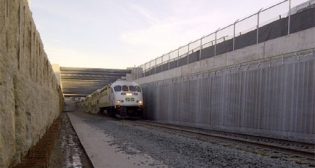
GO Transit marks West Toronto Diamond grade separation progress
GO Transit’s West Toronto Diamond (WTD) continues its progress and marked a milestone in May when the east tunnel opened to rail traffic.
GO Transit’s West Toronto Diamond (WTD) continues its progress and marked a milestone in May when the east tunnel opened to rail traffic.
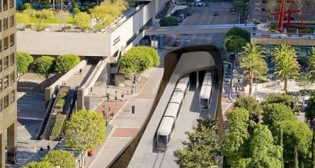
Los Angeles County Metropolitan Transportation Authority (LACMTA) has signed a contract with a joint venture for the construction of the Regional Connector, as well as awarded a design contract for a Metrolink double track project.
Watco has installed two to general manager positions at Great Northwest Railroad (GRNW) and the company’s Wallula switching site.
Stacy Grant has accepted the position of general manager for the GRMW. Grant will be responsible for supervising daily operations, specifically focusing on improving productivity, efficiency and safety. He has been with Watco Transportation Services since September of 2004 when he began working as a conductor for the Palouse River and Coulee City Railroad (PCC). He then served as a trainmaster on the GRNW before being named assistant general manager of the GRNW and the PCC.
Travis Chamberlain has accepted the position of general manager for the Wallula switching site. Chamberlain will be responsible for the day-to-day operations of the site and will report directly to the director of Switching Operations. His duties will be to coordinate efforts between all railroad departments and to achieve performance goals with optimum safety, economy, efficiency and effectiveness, ensuring profitability of all departments.
Chamberlain previously worked in the paper industry at Boise for 11 years before joining the Watco Team in May of this year.
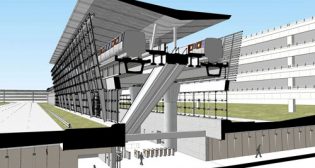
The Metropolitan Washington Airports Authority on July 2 issued a Notice of Recommended Award to Hensel Phelps Construction Co. of Chantilly, Va., to design and build the rail yard and maintenance facility for Phase 2 of the Dulles Corridor Metrorail Project.
VIA Rail Canada celebrated the 110th anniversary of its Ocean service July 2, which serves 26 communities between Montréal and Halifax.
Five railroad crossings will be closed within the next week in Beaumont, Texas, while Union Pacific crews make repairs; all closings are expected to last one day, from 7 a.m. to 5 p.m.
On July 3, repairs will be made at the crossing on Coburn Drive; on July 4, the crossing on Todd Street will see repairs; on July 5, the crossing on Langham Road will see repairs; on July 6, the UP crossing on Keith Road will be closed to through traffic for repairs and on July 7, the crossing on S. Major Drive will see repairs last.
U.S. Sen. Richard Blumenthal (D-Conn.) plans to introduce legislation that he says will enforce and enhance rail safety.
Bay Area Rapid Transit (BART) has passed a Fiscal Year 15 operating and capital budget totaling $1.56 billion that it says prioritizes safety, passenger needs, system reinvestment and on-time performance took effect July 1, 2014.
Two years ago, the Federal Transit Administration (FTA) was granted the authority to oversee the safety of all of America’s individual public transportation systems, writes Theresa McMillan, FTA deputy administrator in the U.S. Department of Transportation’s Fast Lane blog.
Keolis Commuter Services officially began operating the Massachusetts Bay Transportation Authority’s (MBTA) 14 passenger rail lines on July 1, 2014, with a pledge to increase on-time performance and improve safety, cleanliness and customer service.
John Goldman, vice president of the Louisville & Indiana Railroad (L&I) has been promoted to president, effective July 11, succeeding Mike Stolzman, who is joining Colo Railroad Builders in Houston, Texas.
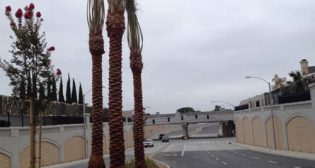
Kraemer Boulevard is now open to traffic as Orange County Transportation Authority (OCTA) puts finishing touches on a new grade separation that separates car traffic from the busy freight rail line that now travels overhead.
It is no secret that rail infrastructure is expensive to maintain and, for North American transit agencies, many of which are working with strained budgets, every dollar spent on a maintenance program must stretch as far as it can go.
Column work has begun for the section of Honolulu Authority for Rapid Transportation’s (HART) elevated rail line that will cross over the H-1/H-2 Freeway merge between Waipahu and Pearl City.
Harsco Corporation received its second major railway track and infrastructure maintenance equipment award from Swiss Federal Railways (SBB) in Switzerland. The award, valued at more than $100 million, calls for 59 high-speed catenary vehicles that will be used for the construction, maintenance and repair of overhead catenary systems throughout Switzerland. Deliveries will begin in 2016 and continue through 2017.
Axion International Holdings, Inc., has received its fifth purchase order for ECOTRAX® rail ties to be shipped to Europe.
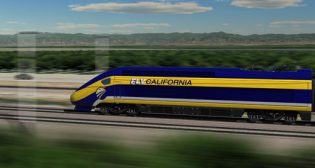
The Federal Railroad Administration (FRA) has issued a Record of Decision (ROD) for the 114-mile Fresno to Bakersfield Section of the California high-speed train system. The ROD is the last step in the National Environmental Policy Act process and clears the way to break ground on the project.
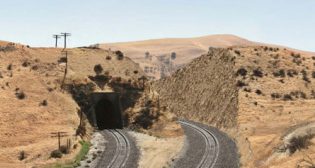
The California Transportation Commission (CTC) has allocated $510 million to 83 transportation projects, including upwards of $113 million for rail-related projects.
Union Pacific (UP) and the Illinois Department of Transportation (IDOT) are making a significant investment in Chicago’s Metra West Line. Each will invest $45 million for the construction of a new third mainline track on the line from River Forest to Melrose Park and then from West Chicago to Geneva.
“Today, we are investing in jobs that will help solidify Illinois’ status as the premier rail center of the nation,” Illinois Gov. Pat Quinn said. “This final piece of the West Line improvement program will enhance commuter and freight travel on one of our state’s busiest rail lines. Building world-class infrastructure is vital to a healthy economy and today’s investment will help get us there.”
The West Line improvements are designed to ensure smoother traffic flow and reduce conflicts between the passenger and freight trains that share the line. Earlier projects completed by Metra and UP modernized the signal system and added crossovers to make freight movement more efficient. A third phase on the West Line, improving the Lombard and Wheaton Metra stations, will be finished in 2015. The West Line third track construction is the final step that will allow the 59 Metra trains and 70 freight trains that use the line each day to operate at the same time, a critical step to improving the line’s reliability and efficiency.
The announcement was made during a celebration to mark the completion of a Chicago Region Environmental and Transportation Efficiency (CREATE) rail project that included the construction of a rail overpass, the rehabilitation of two passenger stations and the addition of pedestrian tunnels in Bellwood and Berkeley and signal and track improvements along the UP/Metra West Line. The project created and supported 1,000 jobs and was funded primarily through a $52-million Transportation Investment Generating Economic Recovery grant, a $27 million commitment from UP and other freight railroad partners, other federal funding of $3 million and a $615,000 investment by the state of Illinois.
“Our nation’s system of bridges, rail and roads is the strength of the nation, tying us together and giving us access to the world,” said U.S. Sen. Dick Durbin (D-IL). “Chicago remains the busiest rail hub in the United States, with more than 1,000 trains passing through the region every day. Protecting and investing in our nation’s infrastructure and specifically in Illinois’ transportation network, is one of my top priorities.”
“This is a new day for Metra, one in which we want to ensure that every project we execute puts commuters first,” Metra Chairman Martin Oberman said. “We are confident the West Line improvements will greatly improve the commuter experience.”
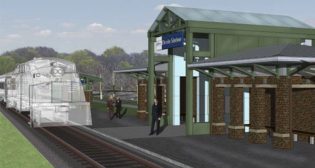
A study released by Charlotte Area Transit System (CATS) shows cost estimates for a proposed passenger line between Mooresville and Charlotte, N.C., rose significantly due to new infrastructure needs rather than using existing infrastructure.