Editor’s Opinion and Commentary –– New York Governor Kathy Hochul Announces Budget Increases to Improve Subway Safety.
Written by David C. Lester, Editor-in-Chief


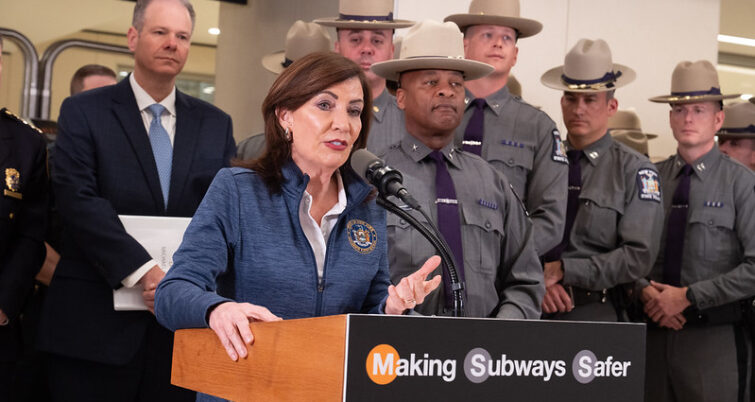
Photo courtesy State of New York
ALBANY, N.Y. -- I have written before about the challenges of subway safety in New York and elsewhere in the United States. I am a huge fan of public transit, especially rail and light rail, and the safety challenges riders and operators have endured for years have been of great concern to me. New York Governor Kathy Hochul announced funding measures to help combat safety issues. The question is, how much good will these investments really do?
First of all, I am not in any way critical of the Governor’s efforts. She’s facing a very tough problem and I’m glad she’s taking steps to combat it.
According to the New York State website, Gov. Hochul announced new funding and renewed measures for improving safety. Here is some of the text outlining the plans:
“Governor Kathy Hochul today joined MTA officials and law enforcement to highlight a FY 2026 New York State Budget deal that delivers on the Governor’s public safety commitments to continue making our subways safer for all riders and transit workers. These major investments increase the presence of law enforcement, make crucial safety upgrades in protective barriers and LED lighting and continue cracking down on fare evasion. New York City’s Subways continue to experience the lowest levels of crime overall outside the pandemic since the 1990s — and as a result of the Governor’s continued efforts to prioritize public safety and make our subways safer, crime is down 11 percent since last year and down 16 percent compared to pre-pandemic levels.“
These numbers are good to hear. But, when it’s said that crime is down 11%, that’s certainly moving in the right direction, but we don’t know the absolute level of crime. How many riders have been harassed or accosted? How many have been injured or killed while riding the subway? Gruesome questions, but they warrant investigation.
On the subject of fare evasion, yes, that’s a problem. However, unless there’s a correlation between folks who avoid fairs and those who commit crime on the subway, it seems fare evasion is a bit of a lightweight subject for a program focused on safety.
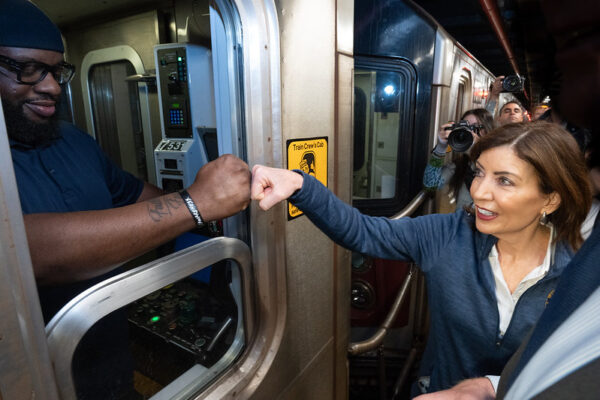
Photo courtesy State of New York
Governor Hochul had this to say:
“When it comes to keeping New Yorkers safe – I refuse to back down, and that is why I fought for a budget that is delivering on my promises to add more police in our subways, invests in crucial safety upgrades, and cracks down on shameless fare evaders,” Governor Hochul said. “For New York City to thrive, our mass transit system must be safe, strong and reliable, and we are delivering a State Budget that supports these goals.”
A strong statement, and no reason to question any of these efforts but, again, the “shameless fare evaders” reference seems out of place.
More remarks about progress in reducing crime, but what are the absolute numbers?
“Earlier this year, Governor Hochul announced comprehensive steps to increase law enforcement presence, expand public resources and strengthen mental health policies to make the transit system safer for New Yorkers. As a result, subway crime is down 11 percent year-to-date in 2025 and 16 percent compared to pre-pandemic levels in 2019. Additionally, serious crimes in New York City are down 8 percent year-to-date compared to the same period in 2024.“
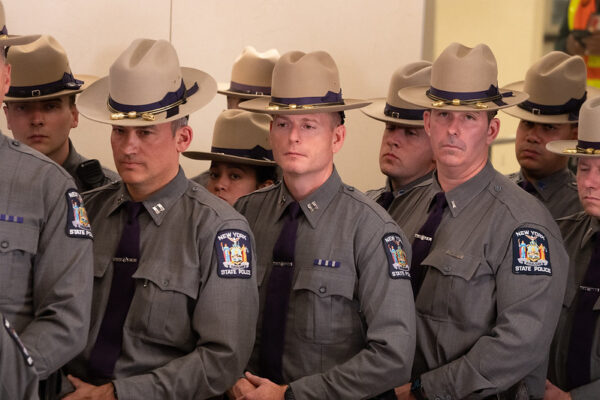
Photo courtesy State of New York
Here are some specifics around the funding the new program will provide:
Increased Patrols and Safety Measures
- “$77 million to partner with NYPD to increase police presence on platforms and trains by temporarily surging patrol levels for six months.
- An additional $45 million for the National Guard Empire Shield mission to continue to deter and prevent terrorist activity in the New York City area, including transit and commuter hubs.“
Partnering with NYPD to increase police presence is a good idea. However, why the six-month time limit on this? I presume it’s a budgetary issue, but if this is not going to be permanent, I fail to see what the long-term benefits will be.
Mental Health Investments
- Deploying Safe Options Support (SOS) teams across the subway to deliver timely care directly to individuals, including helping more than 700 NYC residents experiencing chronic homelessness achieve permanent housing.
- Working with the NYC Department of Homeless Services to expand their 24/7 “Welcome Center” model and creating spaces for mobile outreach teams to better connect and coordinate services, including for Subway Co-Response Outreach Teams (SCOUT) teams trained to address the most severe cases of mental health crisis within the subway system.
The “Safe Options Support (SOS)” teams sound like a good idea. In my view, any effort to help homeless is worthwhile. However, in the subway environment, this is a tougher assignment. For example, if one of the SOS team members approaches a homeless person suffering from mental illness, and that person is combative and refuses to move, will the SOS person be accompanied by a police officer? The post-train efforts to help homeless to achieve permanent housing is a worthy effort, but compared to the number of homeless, 700 sounds like a small number. But, it’s at least 700 people receiving care who otherwise wouldn’t.
The “Welcome Center” sounds like a good idea, and expanding it is even better. So, no quarrels here. Yet, the SCOUT teams sound as though they’ll be the ones who will address “the most severe cases of mental health crisis within the subway system.” This brings up the question, again, of whether these individuals will be accompanied by one or more law enforcement officers.
Infrastructure Improvements
- Making the biggest capital investment in New York’s transportation history by fully funding the MTA’s proposed $68.4 billion 2025-2029 Capital Plan to build the Interborough Express, crack down on fare evasion and focus on much needed repairs and upgrades.
- Installing new protective barriers on subway platforms to protect riders and LED lighting in all subway stations throughout the system to increase visibility throughout the stations.
- Install new fare gate systems in more than 150 subway stations to increase fare collection and improve accessibility.
Infrastructure improvements are always good, and the ones listed here, unless there’s a correlation between fare evaders and those who commit crimes on the subway, don’t seem to do a whole lot to improve rider and operator safety. Better lighting is always good, and the protective barriers sound like a good idea, but details on exactly how they will work and protect passengers and operators are unclear.
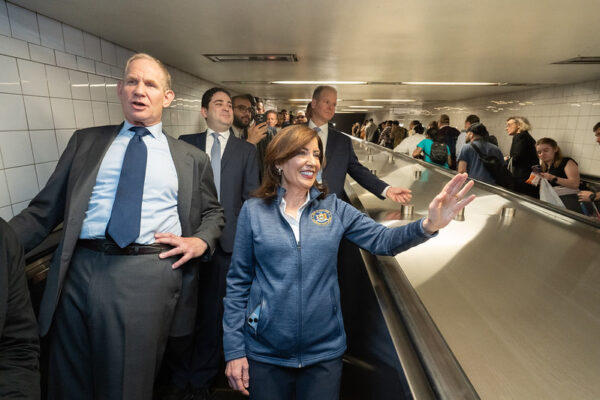
Photo courtesy of State of New York
Conclusions
I offer these comments as a basis for discussion, and not criticism. I am sometimes amazed at the way homeless people are treated in this country. There’s always the debate around if you give cash to a homeless person on the street, is he or she going to buy food with it or drugs and alcohol? There’s really no way to know. However, calling a person a “bum” and assuming the worst is despicable. You may decide not to give the person any cash, but don’t fail to do so because you think they are a bum.
Regarding homeless and mentally ill people on the subway, this is a different challenge because the subway is designed to transport passengers in a safe and comfortable environment where they and operators won’t be harassed or assaulted. Stories of people being set on fire or pushed in front of an arriving train are horrific.
While I applaud state and local efforts to address these issues, I believe that federal funds are needed to address the problem. I’m not an expert on issues surrounding the homeless, but a country with the resources of the United States should be able to address them. However, I think most people take an “out of sight, out of mind” view when it comes to homeless. And, many subway riders approach getting aboard with trepidation and fear. This should not be.
I believe like a number of problems in this country, there is not the political will to spend the money to eliminate the homeless challenges and safety on the subway.
I wish Governor Hochul and her team well on the latest efforts. However, I believe more is needed, and whether we’ll see the resources needed to eliminate this issue remains to be seen.