Transportation Safety Board of Canada Releases Report on CPKC 2024 Yard Derailment
Written by David C. Lester, Editor-in-Chief


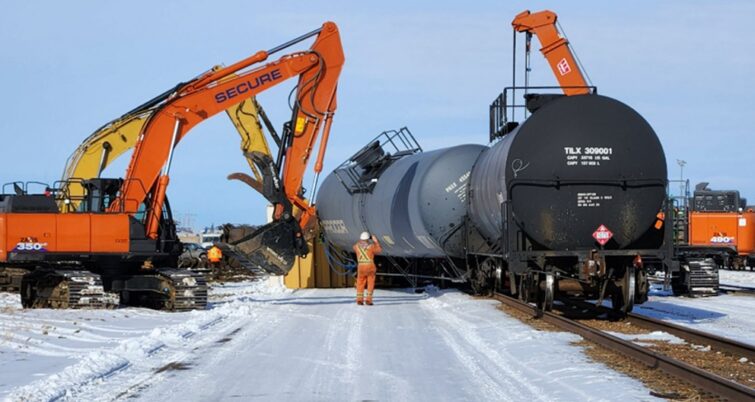
Derailed tank car after collision. (TSB Photo)
CALGARY, Alberta –– The Transportation Safety Board of Canada (TSB) this week released it's report on a 2024 CPKC yard derailment.
Summary
The report summary said that on February 11, 2024 at about 0156 Mountain Standard Time, a CPKC yard crew was operating an assignment [train] at Kipp Yard in Coalhurst, Alberta. This train struck a cut of 79 stationary cars at 13 mph, causing 11 cars to derail, and some of these cars contained dangerous materials. No one was injured and none of the cars leaked.
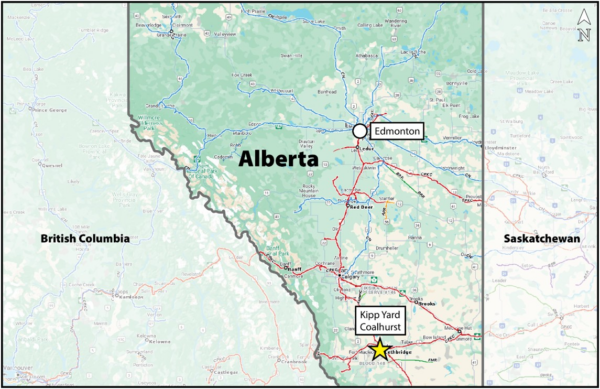
Map showing the location of Kipp Yard in Alberta (Source: Railway Association of Canada, Canadian Rail Atlas, with TSB annotations) (Map courtesy TSB)
Additional Detail
The train was operated using a remote control locomotive system (RCLS). There was a terminal trainmaster on duty supervising operations in the yard, and the crew consisted of a yard foreman, and a yard helper, who were later joined by a utility employee. The trainmaster, however, was not supervising the yard crew during the operation.
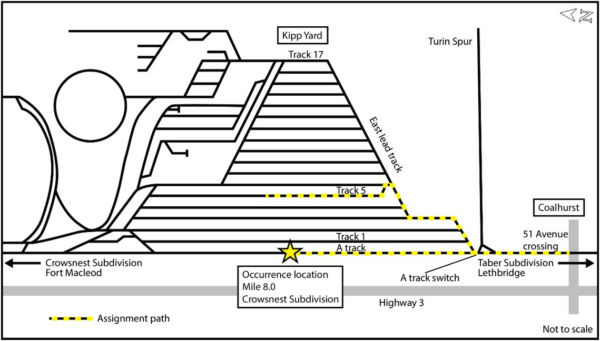
Schematic of the tracks at Kipp Yard showing the path of assignment CK31-10 during the double-over operation (Source: TSB)
Before the move, the CPKC crew assigned to move the train held a job briefing to determine exactly how the operation would be conducted. The report said “They decided that the foreman and helper would ride the locomotive and provide point protection for the forward move; (Providing point protection means ensuring that the track is clear and that the switches are correctly lined) the utility employee, for his part, would provide point protection for the reverse move and couple the [two] cuts of cars. For both the forward and reverse moves, the foreman would control the locomotive using his RCLS operator control unit (OCU). During the reverse move, the utility employee would use a portable [two]-way radio to provide car counts to the foreman (i.e., indicate the maximum distance to travel, expressed in car lengths).”
After the movement commenced, the train, consisting of 66 cars, was pulled out of Track 5 (see diagram above). The train was moved along the east lead track to the A track switch, and after the last car cleared the switch, the utility employee lined the switch for track A, then told the foreman that he could begin the reverse move on A track, and reported that the track was clear for a distance of 50 car lengths or about 2500 feet, which the foreman acknowledged.
The employees proceeded as agreed and pulled the 66 cars out of track 5. After the last car went past the A-track switch, the utility employee returned the switch to the normal position and indicated to the foreman that he could begin the reverse move on A track. The utility employee provided an initial count of 50 cars (this indicated that A track was clear for a distance of 50 car lengths—about 2500 feet). The foreman acknowledged the car count.
The TSB report goes on to say that “The movement began reversing and the utility employee watched until it occupied the A-track switch. He then boarded the utility vehicle and provided another count of 50 cars, which the foreman acknowledged. He then began driving toward the location of the stationary cars to be coupled.
“After the movement had covered about 1910 feet, the utility employee, while driving, provided a third count of 50 cars. The remaining distance to the stationary cars was about 3340 feet. In response, in anticipation of having to slow the train, the foreman selected the Coast function on the OCU (this function places the throttle in the Idle position and removes tractive effort).
“When the utility employee arrived at the stationary cars, he realized that he had lost sight of the lead car of the movement and he reversed the utility vehicle eastward. During this time, he did not provide any progress report to the foreman.
“When the utility employee regained sight of the movement, he resumed driving forward and provided the foreman a count of 30 cars. The foreman made a medium brake application.
“Almost immediately after, the utility employee provided a warning to the foreman that the speed of the movement was too high and gave several car counts in quick succession (15 cars, 10 cars, 5 cars) that were then followed by an instruction to stop. The foreman responded to the quick series of instructions first by making a full service brake application, then by placing the OCU speed selector in the Stop position. However, the train did not stop in time to avert a collision. At about 0158, the assignment [train] collided with the stationary cut of 79 cars at about 13 mph.”
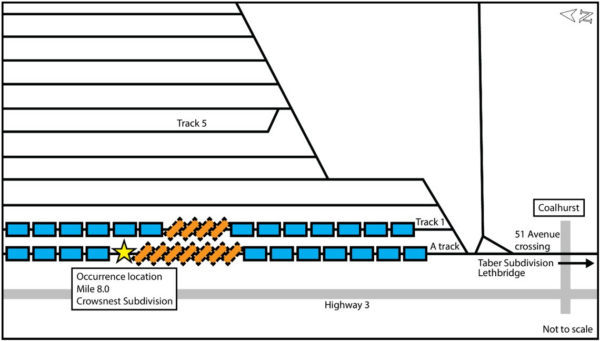
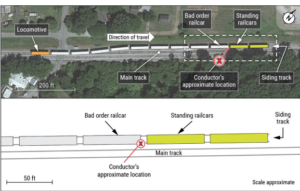
Position of the 11 derailed cars (Source: TSB)
The collision resulted in the seven leading cars on the assignment train derailing in a jackknife position, and struck cars on an adjacent track (track 1) and four cars on this track derailed. (See figure above).
Key Findings of the Investigation
The TSB investigation of the incident led to the following finding of causes and contributing factors:
“During a double-over switching operation at Kipp Yard in Coalhurst, Alberta, a cut of 66 cars was being reversed to be coupled to a cut of 79 stationary cars; due to an inaccurate estimate of the remaining distance to the coupling, the reverse movement collided with the stationary cars at about 13 mph, resulting in the derailment of 11 cars.”
The report also concluded that “The crew’s approach to the reverse move included numerous adaptations to written directions, reducing the safety margins that these directions were meant to provide.
“When defences against unsafe adaptations of written directions are not supplemented by additional layers that do not rely on compliance enforcement, there is an increased risk that adaptations resulting in reduced safety margins will lead to an accident.”
In addition: “The utility employee was driving in a vehicle at night while providing switching instructions over a portable 2-way radio. This high cognitive load, combined with a degraded ability to estimate distance due to the darkness, reduced his ability to provide accurate distance estimation instructions to the foreman.”
“In this occurrence, the helper and the foreman had about 5 and 6 months of experience respectively, and the utility employee had about 1 year. While they were all trained and qualified for their roles, they likely did not have the necessary experience to recognize the increased risk associated with their adaptations of the written instructions until after it was too late to avoid a collision. When paired in a crew, inexperienced crew members may not have sufficient experience to ensure that the risks of certain actions and decisions are fully understood.
The Transportation Safety Board of Canada’s findings are restated below:
Findings
Findings as to causes and contributing factors
These are the factors that were found to have caused or contributed to the occurrence.
- During a double-over switching operation at Kipp Yard in Coalhurst, Alberta, a cut of 66 cars was being reversed to be coupled to a cut of 79 stationary cars; due to an inaccurate estimate of the remaining distance to the coupling, the reverse movement collided with the stationary cars at about 13 mph, resulting in the derailment of 11 cars.
- The crew’s approach to the reverse move included numerous adaptations to written directions, reducing the safety margins that these directions were meant to provide.
- The utility employee was driving in a vehicle at night while providing switching instructions over a portable 2-way radio. This high cognitive load, combined with a degraded ability to estimate distance due to the darkness, reduced his ability to provide accurate distance estimation instructions to the foreman.
Findings as to risk
These are the factors in the occurrence that were found to pose a risk to the transportation system. These factors may or may not have been causal or contributing to the occurrence but could pose a risk in the future.
- When defences against unsafe adaptations of written directions are not supplemented by additional layers that do not rely on compliance enforcement, there is an increased risk that adaptations resulting in reduced safety margins will lead to an accident.
- When inexperienced crew members are paired, there may not be sufficient experience within the crew to ensure that the risks of certain actions and decisions are fully understood.
To read the entire report, please follow this link.
Media
RELATED ARTICLES