Was It Just My Imagination?
Written by Brad Kerchof, Norfolk Southern (retired)


The Value of Riding Trains & Talking With Crews
Hi-rail and walking inspections and automated track geometry testing — the traditional means of track inspection — provide a wealth of actionable information. But another less-emphasized method of inspection — riding trains and conversing with train crews — can also provide valuable insights.
That was certainly the case for me in 2004 when I rode the head end of a double-stack train from Sheffield, AL to Memphis on Norfolk Southern’s “A” Line. It was late afternoon, well after quitting time of the local track supervisor and his maintenance gang, when we rolled through Grand Junction, TN, the headquarters town of the Grand Junction subdivision. Standing on the top step of the locomotive’s center stairwell, my face pressed against the windshield, I looked over the short hood and down at the track. At 40 mph, I had a bit more than a second to evaluate a no. 10 turnout, from switch point to frog. In that brief moment I didn’t notice anything unusual. But after the locomotive had passed the frog, an image appeared in my mind: a joint bar laying face up in the gage of the track, next to the toe block of the spring frog. Did I really see that? I asked myself. I questioned if a dislodged bar was even possible, given that the joint was secured by five bolts, the line was inspected twice a week, and the turnout was literally 100 feet from the track supervisor’s office. Na, not possible, I concluded. It was just my imagination, and certainly not worth placing a 10-mph slow order and calling the supervisor.
I stuck with my plan to spend the night at a Memphis motel and report to the Grand Junction headquarters the next morning. Upon arriving, and under the guise of stretching my legs prior to the track gang’s safety meeting, I walked over to the turnout to confirm that the spring frog’s toe block was indeed fully intact. But there it was — the main-line side joint bar laying face up in the gage of the track. After a few “holy s*!#s,” I contacted the dispatcher to place that 10-mph slow order and enlisted the track gang’s help to reassemble the joint.
Through the previous night, a half dozen trains had run over this turnout. Fortunately, the construction of the joint — a tie plate that spanned multiple ties, a toe block that remained in place, and fasteners on adjacent ties still doing their job — had kept the rail ends aligned enough to allow safe passage of those trains and their several thousand wheels.
A learning experience? You bet. And, no, the lesson was not that a joint bar is an optional piece of track material. Rather, I realized that I needed to trust my eyes (as well as the images subsequently displayed in my mind), and to absolutely investigate further.
This lesson squared very well with what I came to understand later in my career. While failures — both material and human — are common, catastrophes resulting from those failures are not inevitable. Just as often as not, infrastructure, equipment and people will give a hint of a developing problem. We just need to be out on the property, paying attention, to see it.
Brad Kerchof was Division Engineer of NS’s Alabama Division through the 2000s and retired as NS’s Director Research & Tests in Roanoke, VA in 2019.
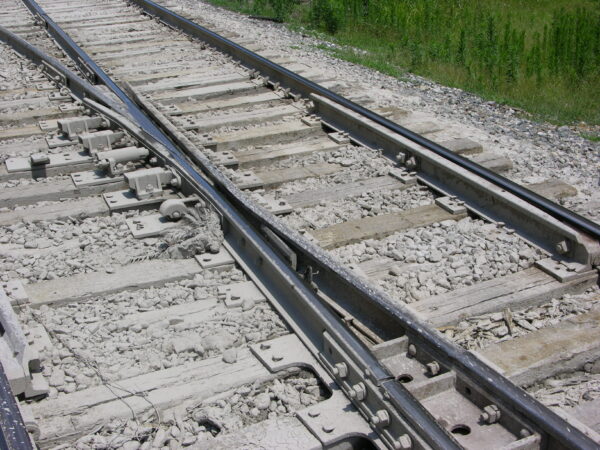
A bolted no. 10 spring frog similar to the one I inspected in Grand Junction in 2004. The joint bar that I found laying in the gage is in the foreground, lower center right. Photo by Gary Wolf.
Spring frogs are used in main-track turnouts where the diverging side sees light traffic and slow speeds (typically 10-15 mph). The advantage of a spring frog is that it does not have a flangeway opening to the main line side, which greatly reduces wheel impact (and thus frog maintenance). BK
THIS ARTICLE APPEARS IN THE MARCH 2025 ISSUE OF RAILWAY TRACK & STRUCTURES