The Importance of Rolling Stock Health to Track Health
Written by Matthew Dick, P.E., VP of Strategy & Business Development, ENSCO Inc., Pueblo, Colo.


Courtesy of ENSCO Rail
PUEBLO, Colo. - From the July 2025 issue of Railway Track and Structures, ENSCO's Matthew Dick writes about managing wheel forces through proper maintenance of rolling stock.
Track infrastructure inspection and maintenance are fundamental to safe and efficient rail transportation and a central focal of RT&S. This article highlights how the condition of rolling stock directly impacts track infrastructure. Most track deterioration is caused by the rolling stock traversing it, and poor rolling stock condition can accelerate that damage. The reverse is also true: degraded tracks can worsen the condition of the vehicles running on it. Both the rolling stock and track infrastructure are parts of an integrated system and maintain both in good health leads to better performance and reduced risk.
Truck Steering Fundamentals
The lateral wheel forces imparted into the track can cause many track maintenance challenges including rail wear, Rolling Contact Fatigue (RCF), rail seat deterioration in concrete ties, plate cutting in wood ties, broken fasteners, and deteriorated ties. These conditions are of course a large portion of track maintenance and if unaddressed can lead to derailment risk.
The weight of the car is one of the largest factors to drive lateral wheel load in curves. Its intuitive that the weight of the railcar directly correlates to the vertical wheel load. But how does it affect the lateral wheel load? Entire books have been written on this phenomenon, but here is a simplified explanation – rolling contact between the wheel and rail is not perfect. There is micro slippage occurring at the wheel/rail contact patch (referred to as creepage) which causes forces from the adhesion (known as creep force). Creep force is an essential and valuable phenomenon because it is what steers railcars through curves. We all know that the tapered wheel treads are what steer cars through curves due to their self-adjusting effective diameters (like a paper cup rolling in a curve on a tabletop). But the underlying mechanism causing the steering is creep forces at the contact patches. These creep forces push and pull individual wheels of a wheel set causing a turning yaw effect to the wheel set (which then helps turn the truck to go around the curve). When operating as intended, the creep forces can often steer the trucks through shallow curves without even flanging.
What causes the lateral wheel forces in curves? There are two sources: first is flanging forces which are simply the normal contact forces between the wheel flange and rail gauge face. But the second is caused by creep force at the wheel/rail contact patch. Curving wheel sets are often not perfectly radial to the curve, meaning it has a slight yaw angle, known as Angle of Attack. The creep force at the wheel/rail contact patch is divided up with the majority going into the rail longitudinally, but some going laterally. The greater the Angle of Attack, the greater the portion of the creep force goes laterally into the rail, causing higher lateral wheel loads.
How does vertical wheel load affect lateral wheel load? Vertical wheel force combined with creepage and rail friction is what causes creep forces. Increasing any one of them (vertical wheel force, creepage, or rail friction) will increase the creep force. It is important to restate that the effect of friction on lateral wheel loads is more complicated than solely high friction equals high lateral wheel loads. This is because lateral wheel load is the combination of normal contact from wheel flanging and contact patch creep forces. An example of this is having a tight curve with dry rails except for a heavily lubricated gauge face high rail. In this scenario, the high rail wheel flanges are attempting to steer the truck but can’t effectively because the very low friction at the wheel/rail contact on the flange is diminishing the beneficial longitudinal creep force that would normally help the truck steer around the curve. Because of this, the wheel set incurs a high Angle of Attack that when paired with the low rail wheel on dry rail, causes high lateral creep force on the low rail which forces the high rail wheel to have increased normal contact at the flange. In this scenario it would be common that the high rail gauge face may not wear as much, but its fasteners and ties would have a greater chance of failure allowing gauge spreading. This is why it’s best practice to pair high rail gauge face lubrication with low rail top-of-rail lubrication to limit the lateral creep forces.
Rolling Stock Maintenance
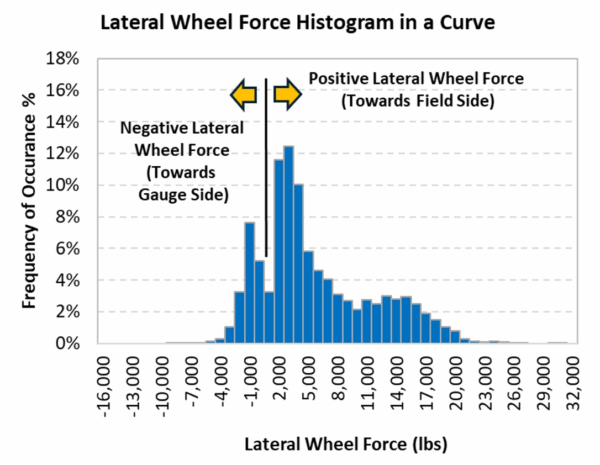
Even if every railcar was in perfect condition, some track wear would still occur. But what rolling stock maintenance conditions can exacerbate track deterioration? Of the three contributors to creep forces (vertical wheel force, creepage, and rail friction) only creepage is significantly affected by rolling stock maintenance condition. Creepage can be affected by disruption of the self-adjusting rolling diameters of a wheel set. Examples of this include the wheel treads being worn to have incorrect tapers in their wheel profile or mis-matched wheel diameters. In this situation the wheel set is unable to achieve a harmonious adjustment of effective rolling diameters, so increased creepage occurs. Additionally, this scenario often increases the Angle of Attack because of its diminished steering causing increased lateral creep force, with the already increased creep force from the increased creepage. Figure 1 depicts how the lateral wheel force can differ drastically from various rolling stock due to their various conditions. Interestingly the negative lateral wheel force (towards the gauge side) is solely due to the creep force at the contact patch.
Two-Point Contact Issues
Another maintenance concern is two-point contact, where a wheel has two distinct contact areas with the rail instead of one. This can happen with hollow worn wheels or with gauge worn rail. In this scenario the two contact patches within a single wheel are far apart from each other as shown in Figure 2. This causes conflicting effective rolling diameters, increased creepage, and fighting steering forces within the wheel set, resulting in elevated lateral wheel forces. Measuring wheel profiles consistently with a Wheel Profile Detector is useful to ensure proper wheel tread tapers.
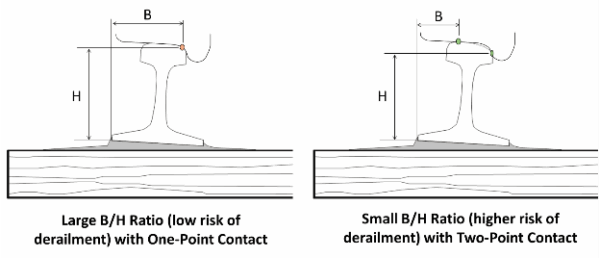
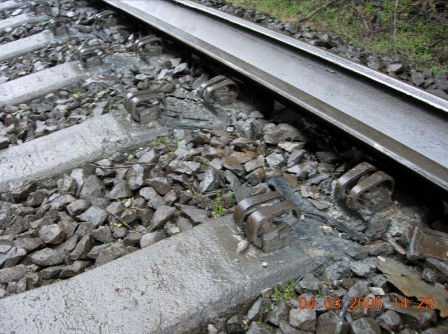
A low B/H from two-point contact can lead to rail seat damage and even rail rollover, especially in concrete ties. Concrete tie showing rail seat deterioration and evidence of rail rollover is shown in Figure 3.
There are additional truck maintenance factors also involved that can affect Angle of Attack. Freight trucks (specifically three-piece trucks) can also introduce issues such as improper side bearing setup heights, binding at the center bowl and worn friction wedges, which can allow excessive truck warping. All these factors can worsen the Angle of Attack. Technologies like Wayside detectors that assess truck steering such as T-BOGI or a Truck Performance Detector (TPD) are useful to help railroads identify trucks with poor steering performance.
It’s important to distinguish between a single problematic railcar and systemic issues across a fleet. A single car with truck steering challenges may pose a derailment risk but it does not necessarily have a large effect on track infrastructure deterioration. However, if the majority of the network fleet suffers from poor steering performance, track deterioration will increase significantly. Railways with captive fleets (such as metro systems or mining railroads) can more easily manage their relationship between rolling stock and infrastructure. On the North American freight network, however, much of the rolling stock is privately owned, posing a greater challenge. Despite that, improving the health of rolling stock remains a high priority industry-wide.
Conclusion
Track deterioration is largely driven by the wheel forces from passing trains. Managing these forces, especially through proper maintenance of rolling stock, is a key way to extend track life and improve safety. At the Transportation Technology Center, ENSCO operates several tools to study these interactions. One is the Wheel Rail Mechanism Loop (WRM), a 3.5-mile test track with varying curves between 4 to 12 degrees.
Track and safety professionals can also have an opportunity to dive deeper into these topics at the upcoming Derailment Investigation and Prevention Workshop, held July 22-24 at TTC. Learn more at ttc-ensco.com.
References
- M.G. Dick, D.S. McConnell, and H.C. Iwand, “Experimental Measurement and Finite Element Modeling of Screw Spike Fatigue Loads”, Proceedings of 2007 ASME/IEEE Joint Rail Conference, ASME, 2007.
- M.G. Dick, “Rail Stability” Proceedings of the 2012 Wheel Rail Interface Seminar, 2012
- Marquis, B. P., Muhlanger, M., Jeong, D. Y., “Effect of Wheel/Rail Loads on Concrete Tie Stresses and Rail Rollover”, Proceedings of the 2011 ASME Rail Transportation Division Fall Technical Conference, 2011