Texas High-Speed Rail Faces Another Obstacle
Written by David C. Lester, Editor-in-Chief


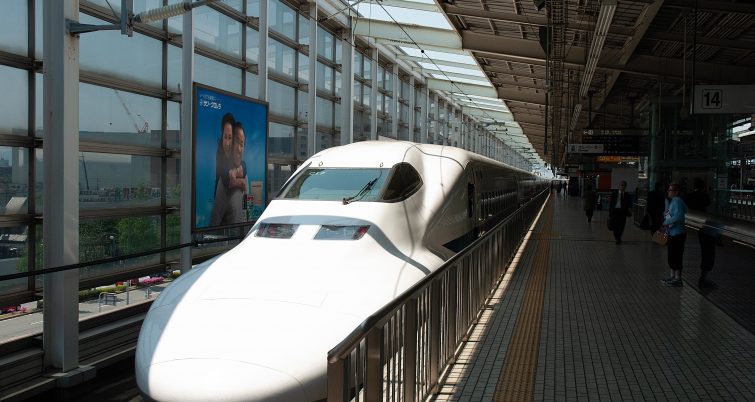
The Shinkansen, or Japanese bullet train, pulls into a station in Japan. This is the type of train proposed for the Texas Central.
David C. Lester
HOUSTON –– The Texas state legislature has prepared a bill that would prevent the construction of high-speed rail service between Houston and Dallas from interfering with or altering any existing roads or highways, making routing of the proposed service much more difficult.
Houston Public Media has reported that State House Bill 1402 was presented and debated this week by Texas House Subcommittee on Transportation Funding and was written by state Rep. Cody Harris of East Texas (R-District 8). This bill would make it illegal to use local or state funding to make any changes to roadways during the construction of the proposed high-speed rail line between Houston and Dallas, which are the two largest cities in Texas.
During the past ten years, proponents have tried to move a 240-mile high-speed rail project between the cities forward, but with virtually no progress. The train, fashioned after the Japanese Bullet Train Shinkansen, would travel between Houston and Dallas in 90 minutes.
Harris said “Texas Central [the company promoting the line] wants to skirt paying local property taxes that were owed but use local property tax dollars to pay for their project. Bill 1402 prohibits the use of taxpayer dollars in any form from the state to local level from being used to pay for the alteration of the roadway related to the construction of a high-speed rail project.”
Waller County Judge Trey Duhon, who has been a long-time opponent of the rail project, said “I’ve been coming here to the Capitol every session since 2015 to share my concerns about the proposed high-speed rail project. “HB1402 by Chairman Harris will protect state money and ensure that public funds throughout the state are safeguarded from being wasted on a washed up, overhyped, underfunded, bait and switch, high-speed rail project.”
Duhon further argued that “In the future, if a high-speed rail company wants to create a plan that addresses the failures of this project, this bill will keep rogue public entities from accepting and spending funds on projects that are outside of their jurisdiction, as well as ensure that counties like mine aren’t compelled to pay for rerouting of roads that we need exactly where they are.”
Peter LeCody, who is president of Texas Rail Advocates, a nonprofit group that supports passenger railroading said the bill “narrowly defines it [the rule] to a particular mode of transportation –– intercity high-speed rail service that is reasonably expected to reach speeds of at least 110 miles per hour. That doesn’t give us a level playing feel with other forms of transportation. This bill would cripple that ability to advance any high-speed rail project.”
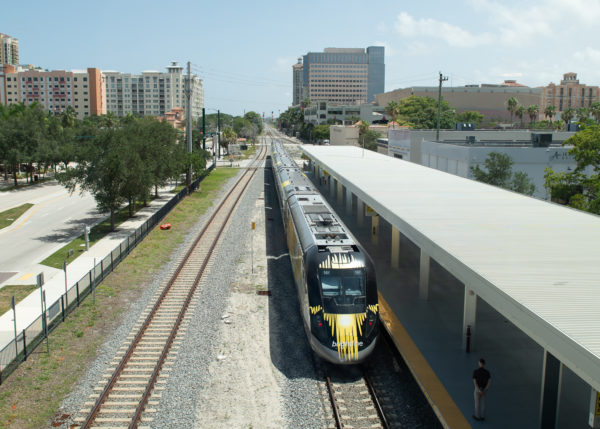
The privately held higher-speed rail company Brightline, which provides service between Miami and Orlando in Florida, is working on an extension to Tampa, and is building the Brightline West line, essentially from Las Vegas to Los Angeles, has made real estate development a key part of the success it’s has enjoyed during the past few years.
However, supporters of the Texas bill say that the prospect of the Texas Central route has thwarted real estate development projects. One company, Delta Tory, is planning a development near Hockley, northwest of Houston. William Papadopoulos, who is with Delta Tory, said “This imaginary line on published maps has prevented us from developing our 993-acre property, where we aim to create jobs within a first-class business part to onshore industry and to grow the regional and state tax base. We also seek to develop affordable housing. Unfortunately, potential homeowners and corporations consider the rail line to be a nuisance.”
RT&S will continue to follow this story.