AutoHaul Drives Efficiencies at Rio Tinto in Australia
Written by Kevin Smith, International Railway Journal


International Railway Journal
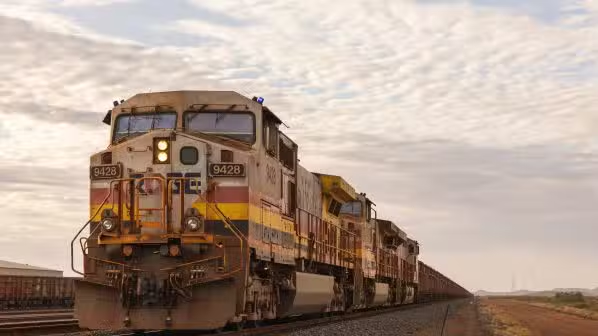
PILBARA REGION OF WESTERN AUSTRAILIA –– Rio Tinto currently operates up to 53 fully autonomous (GoA4) trains simultaneously, each made up of 240 wagons, across its 2,000 km rail network. Photo Credit: Rio Tinto
Eight years since it operated its first driverless heavy-haul freight train in the Pilbara region of Western Australia, and nearly seven since it switched to entirely automated operations, Rio Tinto provides an update on the efficiency improvements delivered by its AutoHaul ATO system. The mining company also reveals some of the current and future upgrades it is working on, as Kevin Smith reports.
IT is nearly seven years since Rio Tinto began operating an entirely automated railway in the Pilbara region of Western Australia. AutoHaul enables trains of up to 2.5km in length to move seamlessly from port to pit and back without a driver onboard, transporting millions of tonnes of iron ore every year and offering dramatic improvements in railway safety and reliability. It is undoubtedly one of the wider industry’s most significant recent achievements and sets the benchmark for other heavy-haul railways around the world as they pursue their own automation ambitions.
Rio Tinto currently operates up to 53 trains of 240 wagons entirely autonomously at Grade of Automation 4 (GoA4) at any one time. Trains run at up to 18-minute headways, 24 hours a day, across the 2000km network, connecting 18 mines with the ports of Dampier and Cape Lambert. Each train can haul around 28,000 tonnes of iron ore, enabling the railway to handle 326.2 million tonnes in the Pilbara in 2025. Similar volumes are anticipated in 2026.
While these volumes are around the same levels shipped before AutoHaul was introduced, the automated rail network is credited for increasing line speeds and driving huge improvements in network efficiency since coming online. In particular, the elimination of the two to three driver handovers during the operation of a single train, which regularly required drivers to meet trains out in the desert, addressed a particular pain point in rail operations.
As Leland Le Breton, general manager for asset management – rail, port and utilities, at Rio Tinto, explained to the workshop session at the International Heavy Haul Association (IHHA) conference in Colorado Springs in November, AutoHaul was intended to address the capacity constraints arising from a boom in demand for iron ore in the early 2000s. This prompted the mining company to increase its ore fleet from 2000 to around 13,500 wagons today, and introduce what Le Breton describes as “a lot of complexity into the network.”
“The challenge was to understand how we can increase our capacity, and how do we start to give ourselves some improvement, without just flooding the network with more trains and building more track,” he says.
Rio Tinto subsequently embarked on the AutoHaul project in 2012, awarding Hitachi Rail STS a contract to develop and introduce the ATO system that makes operation at GoA4 possible (see panel below). While proving more complex, taking longer and costing significantly more than initially expected, Rio Tinto successfully launched entirely automated operation in June 2019. Since then, the company has not looked back, and now only conducts minimal manual driving on its Pilbara railway.
Under AutoHaul, at yards close to the ports of Dampier or Cape Lambert, a driver will board the locomotive to prepare it for the journey. Control is then handed over to the operations control centre (OCC), 1500km away in Perth, which will set the precise route for the train, instructing it to head to a specific mine to load. When it reaches the mine, the train will switch to the automated loading mode that fills each of the 244 wagons with ore, before switching back to mainline operating mode and returning to the port. Trains travel around 600-1000km depending on the mine served, taking up to 42 hours for a single operation.
“With AutoHaul we’ve managed to introduce laser scanners across level crossings so if there is any obstruction, the system will notice it and won’t put a train in that area, when the obstruction clears, it will return the train to its normal journey.” Leland Le Breton, general manager for asset management – rail, port and utilities, at Rio Tinto
As well as enabling more efficient deployment of human resources, AutoHaul is credited with reducing operating costs, including by cutting locomotive fuel consumption, and for improving asset monitoring and management. While AutoHaul performs those duties that the driver would have undertaken in the cab, train control and asset health teams located in the OCC are responsible for making other decisions. They closely monitor trains across the network as they proceed on their journey, receiving alerts or alarms as they occur in order to make the appropriate response.
Le Breton explains that Rio Tinto was assisted in securing acceptance for AutoHaul by the performance-based regulatory environment in Australia. He says this provided the opportunity to innovate, particularly given the emphasis on delivering improvements to performance and safety. “It doesn’t prescribe the rules you need to follow, it says you need to have a safety case,” he says.
“You need to prove in that safety case that the operation you run, the way you manage and address issues, is well managed and is always improving. That’s given us the flexibility to develop AutoHaul and also to think differently about how we tackle some of these safety challenges.”
He points to the example of level crossings where AutoHaul has introduced several new controls that are offering significant improvements compared with the previous system which was solely reliant on the driver.
“With AutoHaul we’ve managed to introduce laser scanners across those level crossings so if there is any obstruction, the system will notice it and won’t put a train in that area,” Le Breton says. “When the obstruction clears, it will return the train to its normal journey.”
Collision Avoidance
AutoHaul also features a collision detection system, which alerts operators if there is an incident during operation. But as this occurs after the fact, the next step is to introduce a collision avoidance system, which is able to identify and issue the appropriate response to the wide range of hazards a train might face during operation.
Rio Tinto has tasked Australian supplier 4AI Systems with “putting eyes on its trains” to help to perceive certain conditions and surroundings. Around 130,000 objects are detected during a typical journey in the Pilbara. Of these, the system will on average identify and observe around 2000 objects that are classed as potential hazards, quickly working out which matter and which do not. The goal is to feed this information directly into AutoHaul, so that trains can respond automatically to factors that might jeopardise safe operation.
As Mark Wood, chief technology officer of 4AI Systems, explains, the Horus solution currently under test at Rio Tinto is trained to recognise objects that it expects to be present, such as fixed infrastructure, level crossings, and points, so it can concentrate on identifying objects that it is not aware of. “It’s ultimately using the processing power onboard as efficiently as possible,” Wood says.
The system integrates various sensors, which are fitted to the locomotive – thermal cameras, which can clearly distinguish biological mass in poor visibility or at night, and three-colour cameras which identify objects at varying distances in daylight. There is also a radar-based system for shorter-range detection. Although limited to line of sight, together these sensors are able to identify objects that are 1600-1800m away.
The majority of these are common objects like vehicles, people or animals. The system is also trained to use patterns of learned behaviour for specific objects to generate the appropriate response. For example, to sound the horn to alert an animal or a person deemed at risk to move out of the way as the train approaches, or to stop the train if there is a rock on the track that could cause a derailment if the train strikes it.
“One thing that is important for Rio Tinto and others is that if we’re going to be slowing down a train that takes 1.5-2km to stop, we don’t want to be stopping for things like tumbleweed or because there is a cow moving away from the danger zone,” Wood says.
The trials with 4AI System are proceeding and Le Breton says that there is still some work to do to identify the precise business rules for the locomotive which will define in which circumstances “we should actually stop.” No timeframe has been given for full deployment.
The OCC
Inevitably taking the driver out of the cab has placed greater responsibility on the train controllers at the Perth OCC, who must make the appropriate response to any anomalies that might occur. Le Breton says that while all of the safety systems are in place and proving effective and consistent, the controllers still have a great deal of information to process, and must be ready to react when the unexpected occurs.
Recognising the challenges and potential risks, Le Breton says Rio Tinto is working to optimise and automate these responses as much as it can. He points to the example of a coupler malfunction. Under conventional signalling systems, Le Breton says the train protection system is switched off to allow a rescue locomotive to enter the occupied track section to recover the train. To overcome this challenge, with AutoHaul a “protection bubble” is placed over the locomotive so it can enter the section without restriction.
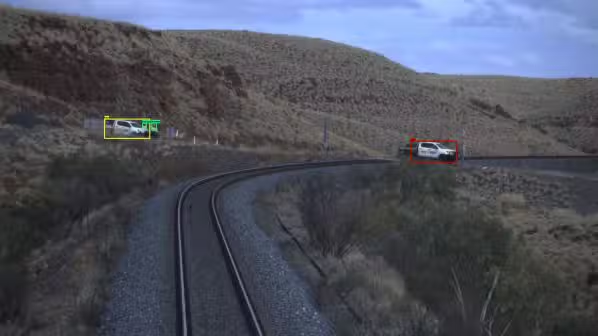
Horus is able to distinguish between objects that pose a hazard to rail operations, such as the truck parked on the track, which is marked in red. Photo: 4AI Systems
“This is quite a complex process and is not something we do too often,” Le Breton says, adding that steps have been taken to lower the potential risks – and ease the potential strain on operators – by identifying any common mistakes that might be made to better understand their consequences, and develop automated responses in order to reduce this risk.
“If they start to make some errors or deviations, the system is alert to that, helping the teams to deal more effectively with these pretty rare and high-risk situations,” Le Breton says.
The improved efficiency offered by AutoHaul is reflected in a reduction of mainline stopping incidents by two-thirds over the last five years. Le Breton says the system’s software is updated every quarter, eliminating bugs that might have caused temporary communication losses or other issues. These system “resets” are also deliverable within just 8 minutes compared with 4 hours in the past, offering what he said is a “massive step-change in productivity.”
Another benefit is the system’s capability to capture high levels of data that is now being actively used to deliver general improvements in network performance. Wayside systems, track conditioning monitoring equipment, and sensors fitted to the ore wagons are all capturing and recording data that Rio Tinto holds in a large integrated dataset, which is subsequently processed and used to inform decision-making throughout the organisation.
“What we’re hoping to build is a continuously upgradable and constantly improving railway.” Leland Le Breton
In practice, this approach has enabled Rio Tinto to conduct more targeted fleet maintenance activities. Le Breton says that around 40% of the trains that passed through yards were able to proceed to the next journey without an engineer having to check any of the 244 wagons. However, by analysing the data, this has increased to 60%.
This work is aided by Recon AI, a tool developed by Rio Tinto, which analyses fleet data and automatically identifies the source of faults in near real time, improving maintenance efficiency. “This is saving our engineers several days a week of just mashing up data, helping us to spend more time on fixing faults and making changes,” Le Breton says.
In addition, rather than taking these decisions in isolation, Le Breton says the technology works to measure the whole-system impact of any decision taken regarding maintenance of a particular asset, including removing a locomotive from service. “If we make decisions on maintenance or access to trains, we can see what that will mean for overall productivity and transport throughput throughout the day,” he says.
Looking to the future, Le Breton says the focus is on continuing to refine the system to unlock further efficiencies. Indeed, he does not anticipate any further “big bang” upgrades, but incremental improvements, with a particular focus on replacing legacy hardware and equipment as it reaches end of life. “We need to think about being more modular and more continuously upgradable,” he says.
“What we’re hoping to build is a continuously upgradable and constantly improving railway so that every quarter, every year, we can continue to push productivity and safety across our network.”
Getting AutoHaul up and running was a major undertaking. But nearly seven years into its automation journey, the effort and money spent is already offering tangible payback and Rio Tinto looks well set to reap the benefits for years to come.
AutoHaul: how it works
AUTOHAUL is equivalent to ERTMS Level 2 albeit with several notable differences, including the use of Rio Tinto’s existing data/UHF radio network rather than GSM-R. There are 60 base stations located across the network, and the radio system was upgraded to meet the demands of AutoHaul. Multiple layers are available if the radio system drops out, including a back-up fibre optic network and a satellite-based system, which is able to provide seamless and continuous communication with trains.
For the train control element, Hitachi Rail STS developed an automated train management system including a centralised vital safety server (VSS), which is essentially a radio block centre (RBC) and the wayside element of the application, which enables safe and flexible management of train movements.
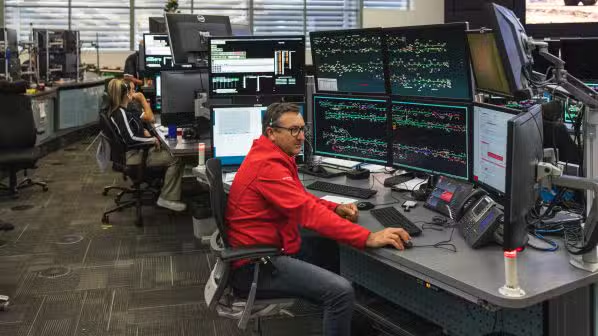
Controllers oversee the automated network from the operations control centre in Perth. Photo: Rio Tinto
The supplier also delivered upgrades to locomotive control systems to support the deployment of electronically-controlled pneumatic (ECP) braking, overseeing installation and system integration of ECP braking on Rio Tinto’s 200-strong locomotive fleet. The locomotives are fitted with collision detection systems; automatic train protection (ATP), which controls train speed and adheres to speed limits; and an onboard video camera to record the forward view from the train.
The ATP system itself uses an interlocking which sets the route according to the commands received by the train control system. The VSS receives the route from the interlocking and transmits this to the onboard unit, providing the movement authority, which follows the distance-left-to-run principle. Like ETCS, the system uses balises for group referencing and to run the lineside elements, although there are several differences including the presence of integrated asset protection across the entire system, which can automatically trigger a change to the limit of authority for the train in response to an alarm generated at the lineside due, for example, to a problem with one of the network’s 42 level crossings. This process occurs through the same chain: through the VSS and via radio to the onboard unit.
The ATO element relies on two separate channels – one from the control centre and the other from the onboard unit, which are linked together and communicate with one another.
Firstly, the ATO system gathers information from the ATP system on the current journey, speed and location of the train, from which the system performs its own calculation for operation. These calculations are also informed by information from the other channel from the control centre.
Unlike the ATP data, this information is not safety-related but necessary for the journey itself. This includes the schedule, as defined by the operator, and the information required for the driving strategy, a sub element of ATO, which includes the track map, a database of the entire network and the algorithm which enters and monitors the train’s journey while it is in service. Connected to this is data for external elements essential for operation such as the throttle, brakes, horns, locomotive information and data loggers.