How It’s Built: Hudson River Ground Stabilization Cofferdam
Written by Gateway Development Commission, Agency Communications


Gateway Development Commission
NEW YORK –– If you’ve looked out at the Hudson River recently, you may have wondered what that big, metal rectangle in the middle of it is. It’s the cofferdam enclosing the Hudson River Ground Stabilization (HRGS) Project work area – a key part of the Hudson Tunnel Project. (All images courtesy of Gateway Development Commission).
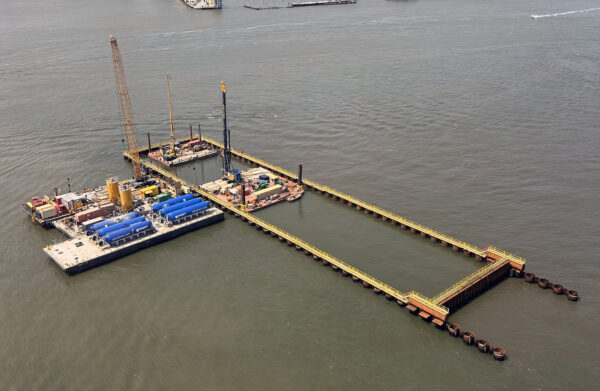
A cofferdam is an enclosure built within a body of water to seal off a smaller area for work to take place. They are one of the oldest construction tools that we still use. Keep reading to learn more about the history of cofferdams, and how we’re adapting this ancient technique to build a modern rail tunnel.
A Roman Technique We Still Use Today
The Roman Empire pioneered the use of cofferdams to build bridges spanning wide rivers. These early cofferdams were made of wooden pillars driven into the riverbed then sealed with clay. Builders then poured a natural cement, called pozzolana, made from volcanic rock mixed with powdered lime, into the dam to create a stable footing that could hold up a bridge.
These bridges were built to stand the test of time. The Sant’Angelo Bridge in Rome still stands on the cofferdam foundations built in the Tiber River more than 1,800 years ago.
The first cofferdams made of steel were built in the early 20th Century. These dams were made of interlocking U-shaped steel sheets to provide greater strength, reusability, and adaptability. This design is still used in many modern cofferdams.
Why We Need a Cofferdam to Build a Tunnel
The HRGS Project is mixing lightweight concrete into the riverbed on the eastern side of the Hudson River to create a stable environment for the tunnel boring machines (TBMs) that are building the new tunnel under the river to drill through.
The area where mixing takes place is enclosed within a temporary cofferdam for two reasons:
- It protects the area where mixing is taking place from the strong currents in the Hudson River.
- It keeps marine life out of the construction site, protecting the river ecosystem.
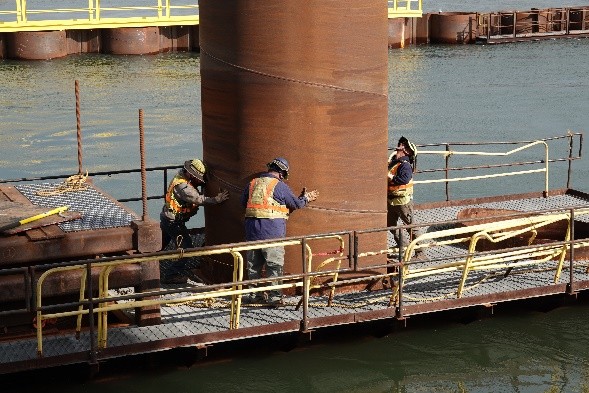
The HRGS cofferdam was installed last summer and fall. It consists of sections of sheet piling – essentially steel walls – between king piles – large, hollow steel cylinders that provide additional strength and stability. Construction teams on barges used vibratory hammers to drive the cofferdam piles into the river bottom. The team installed the king piles through holes in a massive template to make sure they were positioned in the exact right location.
Soon, work will begin to shift the cofferdam east toward Manhattan to enable ground stabilization in a new section of the river. Piles will be pulled from the west end of the cofferdam, where ground stabilization is complete, and reinstalled on the east end of the dam. This “leapfrog” technique will shift the cofferdam east over the summer months while keeping the area of river enclosed roughly the same size.