Decision Making From Software and Ai
Written by Rafael Maldonado, Deputy Division Manager, ENSCO, Inc., Charlottesville, VA Ivan Aragona, Data Management and Digital Solutions Director, ENSCO, Inc., Tampa, FL


Courtesy of ENSCO
CHARLOTTESVILLE, VA. - From the March issue of Railway Track and Structures, Rafael Maldonado and Ivan Aragona from ENSCO, Inc. write about using track inspection technologies to inform maintenance planning.
The Transportation Technology Center (TTC), operated by ENSCO, is a hub for testing and developing cutting-edge railway maintenance solutions. In an industry facing increasing demands for higher speeds, greater tonnage, and enhanced safety, data-driven asset management has become essential for maintaining infrastructure reliability.
Traditionally, track maintenance relied on manual inspections, consolidating information into spreadsheets, and following pre-planned maintenance schedules. Decisions were often based on experience and routine rather than real-time data. With the integration of predictive analytics, advanced track inspection systems, and machine learning, railroads are shifting toward condition-based and predictive maintenance models. This transition enables more targeted maintenance, extends asset life by addressing issues before they become critical, and reduces costs through optimized capital planning.
Track Asset Management System
The ability to maximize the value of track inspection systems and implement a predictive, condition-based maintenance strategy hinges on the development of a well-defined asset register. A comprehensive asset register serves as the foundation for effective track infrastructure management, enabling railroads to integrate real-time condition data into decision-making processes.
Historically, asset registers primarily cataloged physical track infrastructure and operational conditions in track Charts, including point assets (e.g., turnouts, culverts, bridges), linear assets (mainline track, sidings, yard tracks) and operational criteria such as gradient, curvature, and track class/speed limits. As railroads transitioned toward data-driven maintenance strategies, these registers expanded to include component-level details such as tie type, fasteners, and rail type. Geographic Information Systems (GIS) and track chart overlays have further improved data completeness, ensuring a more accurate representation of assets across extensive rail networks.
At a minimum, a modern track asset register consists of several key attributes that collectively support effective track infrastructure management. These include linear and point assets, such as track, turnouts, bridges, and culverts, as well as linear location references, like mile markers, foot markers, and chainage measurements. Geospatial positioning, using GPS coordinates from inspection systems, synchronizes with asset linear locations to improve accuracy.
Additionally, the register includes track design characteristics, such as gradient, tangent, spiral, and curved sections, and track components, including rail type, tie type (wood, concrete, etc.), and fastener type. Operational characteristics, such as track classification and tonnage, further refine the data necessary for decision-making.
At first glance, capturing such a detailed asset register may seem excessive. However, as railroads continue shifting toward data driven maintenance strategies, these detailed records become invaluable for conducting analysis of premature failures and long-term asset performance studies by integrating with track inspection systems condition data.
Advancements in Track Inspection Technologies
Railroads now have access to a wide array of inspection technologies capable of monitoring track conditions at scale with unprecedented accuracy. These systems enhance manual inspections, enabling track inspectors and maintainers to focus on high-priority areas with greater precision. From track geometry measurements to high-resolution imaging, today’s inspection solutions are deployed across a variety of platforms, including dedicated manned inspection vehicles, autonomous in-service rail-bound vehicles, and drones.
Track Geometry Measurement Systems (TGMS) play a fundamental role in assessing rail infrastructure health by measuring gage, crosslevel, alignment, profile, warp, and twist.
Rail flaw detection, once dependent on manual inspections, has greatly improved with Ultrasonic Testing (UT) and Eddy Current Testing (ET), which identify internal rail defects and surface cracks before they become critical.
Vehicle/Track Interaction (V/TI) monitoring provides insight into track conditions under real-world operations, capturing data such as carbody accelerations, truck lateral movements, axle impact loads, and mid-chord offset variations.
Machine vision inspection, using high-resolution cameras and artificial intelligence, automates defect detection for ties, fasteners, ballast conditions, and joint bars.
Other key technologies include Gauge Restraint Measurement Systems (GRMS), which assess track stability under simulated loads, crucial for preventing derailments, especially in heavy-haul operations, and LIDAR-based 3D mapping, which provides detailed models of track corridors for vegetation management, clearance assessments, and track bed analysis.
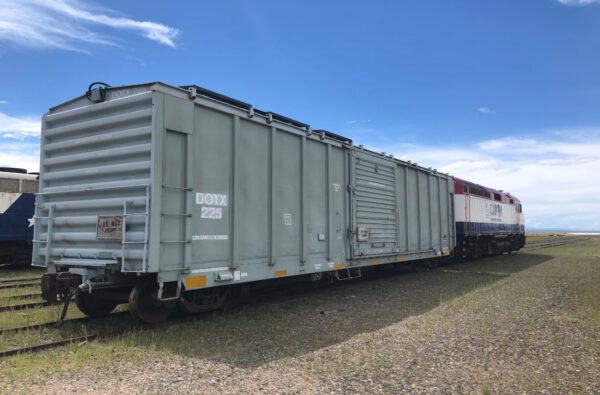
These inspection technologies, when integrated into multi-system platforms, allow for comprehensive data collection in a single survey pass. The Federal Railroad Administration’s (FRA) Automated Track Inspection Program (ATIP) exemplifies this approach, incorporating multiple inspection technologies within a single vehicle to maximize efficiency. Additionally, DOTX 225, now part of the Transportation Technology Center’s (TTC) inventory following its transfer from the FRA, continues to play a role in track assessment and monitoring at the facility.
Transforming Data into Decisions
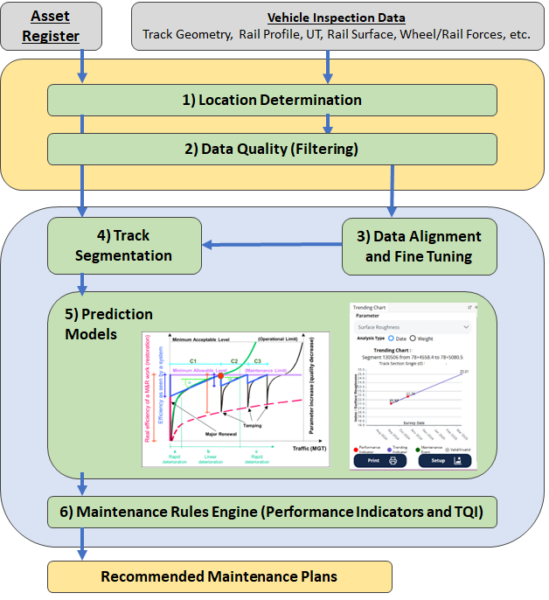
The true value of track condition data lies in its ability to inform maintenance decisions. Raw measurement data must be aggregated, processed, and analyzed to determine which assets require intervention. This process involves several key steps:
- Location Determination: Aligning track inspections data with an asset register ensures consistency across multiple surveys.
- Data Quality Filtering: Predictive systems rely on high-quality inputs; filtering out poor data—such as correcting sunlight interference in optical based systems or replacing invalid readings using historical trends—improves accuracy.
- Data Alignment and Fine Tuning: High-precision alignment, whether manual or automated, is required to enable reliable degradation predictions.
- Track Segmentation: Converting linear railway infrastructure elements into discrete, analyzable segments ensures consistent comparisons across a network.
- Prediction Models: Once data has been aligned, predictive models assess future track conditions. Some preventative maintenance activities have well documented effects, allowing for accurate short-term forecasting and long-term planning.
- Maintenance Rules (Performance Indicators & TQI): Performance indicators and Track Quality Indices (TQIs) are metrics used to assess the overall condition of track segments based on data. While a single defect may trigger an alert, TQIs analyze multiple parameters, enabling strategic, data-driven maintenance recommendations.
Case Study: Condition-Based Maintenance Planning
A condition-based Maintenance of Way (MOW) algorithm was developed to assess track segment health and provide a data-driven approach to maintenance planning. The TQI, derived from this algorithm, serves as a key performance indicator:
Equation 1. Surfacing TQI
TQI = WA × σALG + WP × σPRF + WW × σWRP + WX × σXLVL
where,
σ = Standard deviation of track geometry measurement,
ALG = Alignment (average of the left and right rail measurements),
PRF = Profile (average of the left and right rail),
WRP = Warp,
XLVL = Crosslevel,
W? = Weighting Factor for each parameter
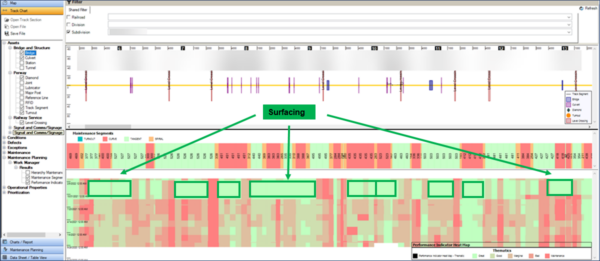
Analyzing TQI data over an 18-month period allowed railroads to identify track segments in need of resurfacing. Figure 3 provides a comprehensive view of the rail linear infrastructure, maintenance segments, and the Surfacing TQI for each segment over time. During a 12-month period, the thematic analysis confirmed poor surfacing conditions, which significantly improved following the surfacing program’s completion. While some areas remained red on the thematic map, further examination revealed that most corresponded to road crossings, where surfacing is typically limited. By using visualization tools, railroads can differentiate between spot surfacing treatments, which raises isolated low spots to prevent deterioration—and out-of-surfacing, which involves raising the entire track to a new uniform height after reballasting.
Looking Ahead at the TTC
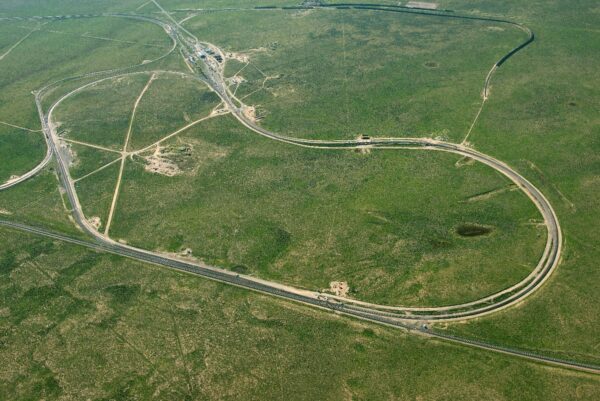
The FRA’s Transportation Technology Center (TTC), operated by ENSCO, provides a scalable environment for validating and improving track geometry forecasting models without impacting revenue service operations. The High Tonnage Loop (HTL) at TTC allows researchers to study track deterioration under accelerated conditions, simulating the impact of heavy freight traffic with daily accumulations of one million gross tons (MGT) of traffic. This unique setting also enables controlled experiments on moisture conditions and their effects on track geometry.
To enhance track maintenance logistics, TTC will soon implement ENSCO’s Automated Maintenance Advisor (AMA). While Class I railroads and transit systems operate on a much larger scale, the fundamental goal remains the same which is identifying potential issues early to prevent failures and extend asset life. By leveraging AI-driven maintenance recommendations, AMA will assist in planning timely interventions, preventing further degradation before conditions become critical.
With TTC’s key tracks in continuous use, minimizing downtime is essential. The integration of AI and automation enables more efficient maintenance planning while ensuring safe, uninterrupted operations—advancing both the science and practice of railway asset management.
For more information on how TTC supports research, testing, and development for the rail industry, visit ttc-ensco.com