Norfolk Southern Achieves Milestone with Digital Train Inspection Portal
Written by Marybeth Luczak, Executive Editor, Railway Age


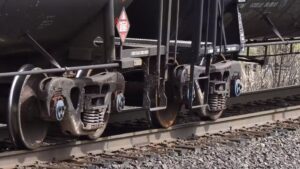
“At Norfolk Southern, we are leveraging cutting-edge AI and enhanced imaging to set new industry standards for safety and operational excellence,” EVP and Chief Information and Digital Officer Anil Bhatt reported via LinkedIn on March 3. “Our Digital Train Inspection portals are a testament to this innovation—combining advanced AI algorithms, developed by our Data Scientists in close collaboration with our Mechanical experts, to analyze railcars at full speed. Each portal captures approximately 1,000 images per passing railcar, generating petabytes of data every month. This vast dataset is processed in real-time by AI models that detect emerging conditions with precision, helping our teams take proactive action.” (Photograph Courtesy of Anil Bhatt)
ATLANTA ––Norfolk Southern (NS) achieves a milestone with its Digital Train Inspection Portal.
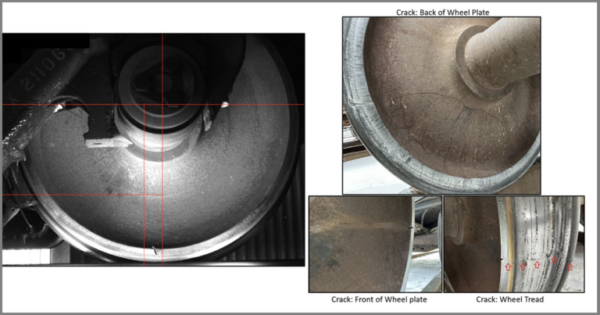
“Recently, we achieved a groundbreaking milestone in the North American rail industry — our AI autonomously detected a hairline crack in a wheel,” NS EVP and Chief Information and Digital Officer Anil Bhatt reported via LinkedIn. (Image Courtesy of Anil Bhatt)
NS on March 3 shared a LinkedIn post by Executive Vice President and Chief Information and Digital Officer Anil Bhatt on its Digital Train Inspection Portals, which launched in 2023. Bhatt, who joined the railroad last summer, provided a “milestone” update on the portals, each of which is equipped with Machine Vision Inspection technology featuring a setup of 24-megapixel trackside cameras and stadium lighting to capture ultra-high-resolution, 360-degree images of passing railcars. The synchronized cameras are said to record 1,000 images per railcar at speeds up to 70 mph, detecting defects at angles “that are difficult to see during stationary inspections.”
“Recently, we achieved a groundbreaking milestone in the North American rail industry — our AI autonomously detected a hairline crack in a wheel,” Bhatt reported (see images above). “Identifying such defects in real-world conditions is an immense challenge, and this breakthrough further strengthens our ability to prevent potential train incidents. As soon as the flaw was detected, our railroaders immediately took action, removing the affected car from service and preventing a potential issue before it could escalate. This is a powerful example of how AI and human expertise come together to enhance safety across our network.”
In 2023, NS announced that it would deploy the portals, whose Machine Vision Inspection Technology was developed in partnership with the Georgia Tech Research Institute, which engineered the hardware, and NS’s Data Science/Artificial Intelligence (AI) and Mechanical teams. The first portal was installed Leetonia, Ohio, where trains pass through approximately every hour; and the second in Jackson, Ga., on NS’s Atlanta South District Subdivision, where approximately 19 trains pass through daily. The railroad now has seven portals in operation.
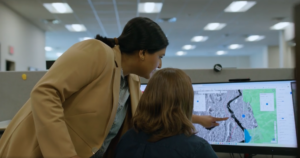
According to NS, the AI transmits the information to the railroad’s Network Operations Center, where the data is reviewed. “Guided by a robust response protocol, subject-matter experts then identify and address issues to proactively ensure the safety of rail operations,” NS reported in April 2024, when it deployed the Jackson, Ga.-based portal. “Critical defects found are flagged for immediate handling. AI analyzes these images for potential defects. Our in-house Data Science/AI team has developed approximately 40 advanced Deep Learning algorithms and already deployed them across heavily trafficked lanes. We plan to roll out an additional 20 algorithms by year’s end. These best-in-class, field-proven algorithms have demonstrated very high accuracy levels, while having very low false-indicators.”