$204MM Secured for Assembly Street Railroad Separation Project (UPDATED 1/27)
Written by Jennifer McLawhorn, Managing Editor


Assembly Street Railroad Separation Project Boundary.
Courtesy of SCDOT
COLUMBIA, S.C. - The city of Columbia received $204 million in federal funding for a separation project.
*Updated: 1/27*
STV announced it “has played a key role in securing a $204 million Federal Railroad Administration (FRA) Railroad Crossing Elimination (RCE) Grant for the City of Columbia, South Carolina.” STV prepared grant documentation on behalf of the city. This helped to secure the necessary funds to move forward with the project. In 2009, STV conducted a study to analyze design alternatives for the Assembly Street project after being contracted by the South Carolina Department of Transportation to provide “conceptual engineering, alternatives analyses, public and stakeholder engagement and National Environment Policy Act (NEPA) services that will facilitate a choice for a preferred alternative for the project – which is expected to be decided later this winter.”
According to the report, the funding comes as part of the Bipartisan Infrastructure Law. The project seeks to separate Assembly Street from the NS and CSX trains that cross over it. SCDOT states the purpose is to “improve rail operations and vehicular connectivity while alleviating vehicle congestion associated with frequent freight rail movements along Assembly Street and surrounding areas located south of downtown Columbia, South Carolina.”
“This marks a pivotal moment for a project that has been decades in the making,” said Katie Curry, project manager at STV. “With momentum building, this grant will help bring a transformative project to life while improving mobility in and around South Carolina’s capital city.”
The total estimated cost is between $275 million and $300 million, but this cost could rise depending on the chosen design option. The rest of the funding is expected to come from Richland County, the City of Columbia, and the South Carolina Department of Transportation.
As a next step, the report states a design option will need to be chosen out of three current options. According to SCDOT’s timeline, this will occur at the end of January. In April, an Environmental Assessment will take place with a NEPA Decision in May/June. Construction is expected to take 18-24 months.
Alternative A
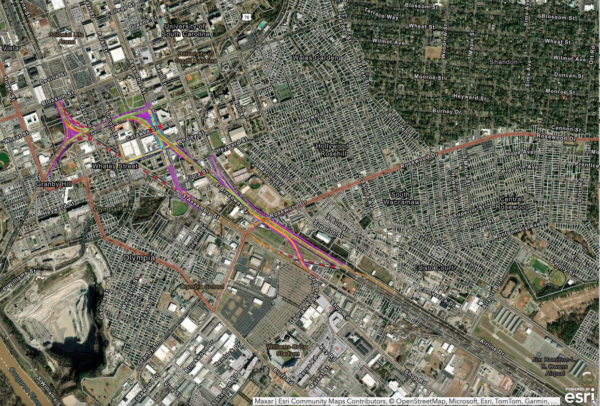
This alternative “involves consolidating a portion of the CSX AKA-Line into the western NS SC-Line.” It proposes rail bridges over Assembly Street between Catawba and Whaley Streets with existing bridges over Whaley and Rosewood receiving modifications to include additional track. To allow for the rail bridge, Assembly Street would be lowered approximately 18 feet. Part of the CSX AKA-Line would be maintained to allow for rail access “to the industry track, located between Virginia Street and Rosewood Drive.”
Alternative A-1
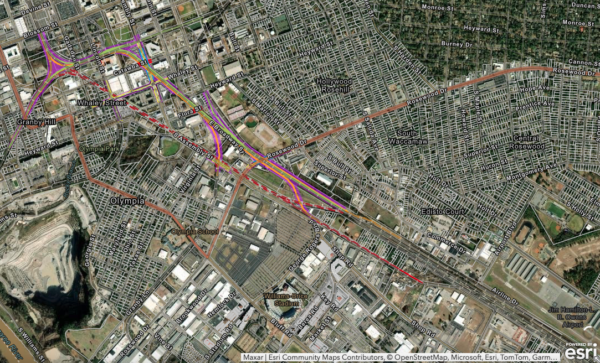
Alternative A-1 includes consolidating part of the CSX AKA-Line into the western NS SC-LIne, and the “CSX line through the CCMD would be abandoned between the NS R-Line to Andrews Yard.” The industry track “would be directly serviced by extending a CSX spur track from the consolidated CSX and NS tracks between Flora Street and Rosewood Drive.” Similar to Alternative A, part of the CSX-AKA Line that parallels Assembly Street would be maintained to provide access to the industry track.
Alternative B
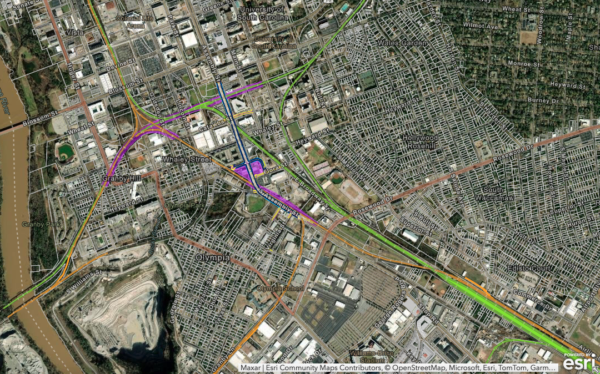
Alternative B would have elevated roadway bridges over the NS SC-Line between Catawba Street and Whaley Street “as well as over the CSX AKA-Line between Flora Street and Ferguson Street.” This would also involve minimal changes to existing rail lines with maintained pedestrian access.